Sunday, June 14, 2015

Site Visit: Five Sullivans Iowa Veterans Museum

Sullivan Brothers Iowa Veterans Museum, Waterloo, IA
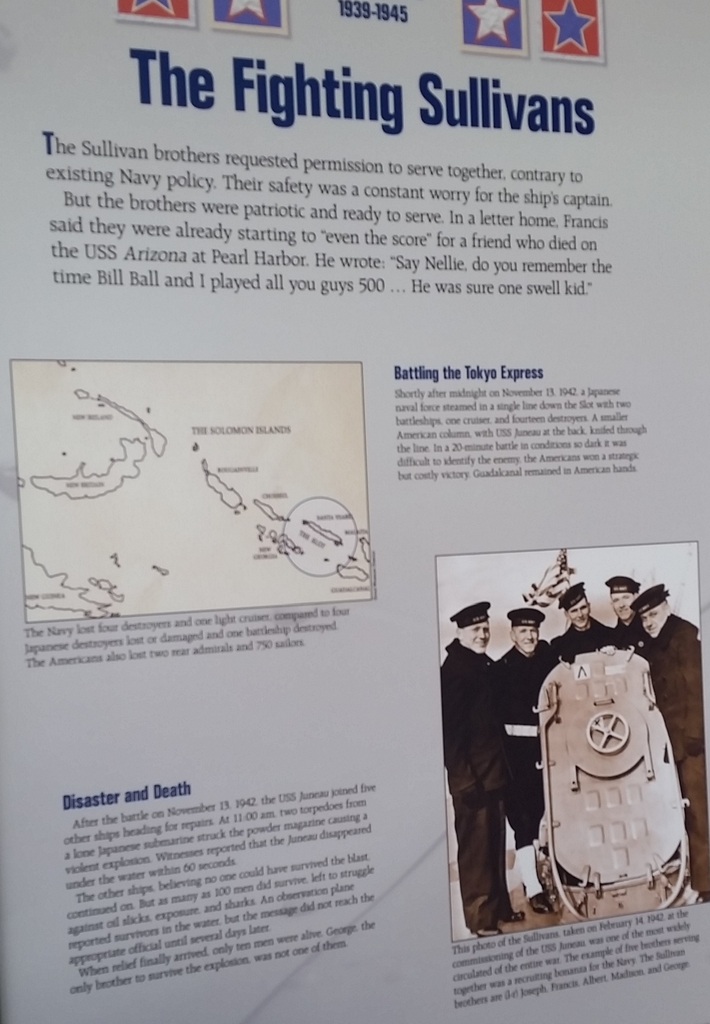
Waterloo, Iowa, has a number of local museums in their downtown area. I decided to go to the Sullivan Brothers Iowa Veterans Museum as a site visit for this month's blog post. The "Five Sullivans" were brothers from Waterloo who joined the Navy after the bombing at Pearl Harbor in December of 1941. In spite of Navy policy to break up family members from service together, they did serve together on the USS Juneau. On November 13, 1942, as part of the Battle of Guadalcanal, Japanese torpedoes sunk the Juneau and all five brothers died as a result.

More information about the Sullivan brothers
The brothers' namesake museum opened in 2008 and is dedicated to preserving the memories and experiences of Iowan soldiers stretching back to the American Civil War (since Iowa became a state in 1846). It is a large complex and has several events throughout the year.

We started down on the ground level because it was the location of the oldest things, pioneer life and the Civil War through to 1920s. Even though I had a map, the flow of the museum confused me. Should I go this way or that way around an exhibit? I ended up going in spiraling clover leaf pathway pattern that saw everything in some sort of order but did a lot of backtracking. There were lots of displays and lots of quick brief placards. High tech interactive touch screen display panels as well as old fashioned glass case displays stood only feet apart from each other, each doing their part of telling the story. There was a mock up of a WWI trench line that had a periscope built in with voice overs and combat sounds. The lower level also incorporated the home front and covered supporting military roles for combat troops, rather than just focusing on the rank-and-file soldiers. Along the back end of the museum was an exhibit on manufacturing and industry in the Cedar Valley area.

Upstairs were the exhibits on WWII to modern conflicts. The upstairs was better designed but flowed
Interactive Mock-ups
in the opposite direction of the downstairs' path of movement. There was a lot more put into this section than down below, I thought. The Second World War area had a large map with laser show overlay that described the military movements of the conflict, and mentioned the sinking of the Juneau and the Sullivans. Besides more interactive placards, recorded video presentations of veterans of the conflicts as well as military support roles and home front memories told their stories of what the war was like. The upper section had mock ups of the "Juneau" bow, a Sherman tank, a jet cockpit, and a Huey helicopter hull that allowed visitors to interact them them. Throughout the entire museum were opportunities to infrared scan a plastic dog tag and learn about how a particular ethnicity reacted to the conflict and how these reactions and involvement changed over time. The upper level ended with the modern day conflicts of Afghanistan and Iraq and raised the issues with veterans' experiences today.

We also visited two traveling exhibits, the first of which was on Mail Call. This exhibit highlighted how the military and postal services worked to improve morale, communication, and mental well-being of soldiers and how it changed over the years. It was a Smithsonian exhibit and was very well done, but I think due to space constraints had to be located in two parts on separate floors, which made it difficult for continuity's sake.The other traveling exhibit from the National Holocaust Museum was about Germany's concerns for creating a genetically superior race. It described the popularity of eugenics and policies that lead to euthanasia and other similar practiced in the 1930s-40s Germany. It was expansive and thorough and utterly depressing. It was also unfortunately the final stop on the way through the museum so it left my wife and me with bitter last thoughts before leaving. Since these were travelling exhibits that the museum hosted, I will exclude them from my analysis of the museum as a whole, but felt I needed to mention them because it was part of my experience.

Home front exhibit on the left, Civil War exhibit on the right
Since my previous site visit to the John Deere Tractor Factory last year, I have been wondering how to properly evaluate a site. The solution I chose to use was compare the museum to Freeman's six interpretive principles and visitor experience considerations. I realize this approach is flawed and probably overlooks a few other factors, but it is a framework that I choose to use, at least for now. I will be paraphrasing the principles.

Principle 1: The interpretation should be personal to the audience. Yes, the content was personal to a large extent, particularly by presenting the content in the forms of eyewitness accounts in interactive panels starting with letters. These letters were rewritten on these panels as a legible handwritten type script accompanied by the actual scanned letters. A recording of a voice actor read the letters aloud made it easier to read and would be beneficial to a person who is blind. A visitor could choose to view none, one, several, or all these options at various interpretive interactive panels using a trackball and a 'click' button. I liked those panels because you chose what you wanted to know more about. Upstairs had the addition of recorded experiences of real people recollecting their stories. This made the material less about the conflict, troop movements, and battles, and more about human stories of tragedy, trial, adversity, and humor.

Principle 2: Information is not interpretation. This museum had a lot of information.
Exhibit on the Spanish-American War. A station on learning
how to salute and whom to salute.
It was everywhere. But as far as I know they do not have interpretive staff. There were two people at the desk when we paid our tickets, but I didn't see any going around explaining their exhibits. It was all self guided. There were placards for an audio tour, but we were not informed of any audio tour at booking, so maybe we missed an opportunity. There were activities, interactive panels, tangibles and placards, but I felt that the information did not translate into interpretation. What did these things mean? How does this relate to my life if I was not a soldier? The activities were fun, challenging, and informative, but they fell just short of stimulating a response that had meaning or understanding of what this activity meant for the people who did this as a part of their lives. I would suggest that a visit to the Sullivan Brothers Iowa Veterans Museum is an informational visit rather than an interpretive experience.

Principle 3: Interpretation is an art, which combines many arts. Since no person was there to make an interpretive presentation, I decided to take some liberty in answering this category. I viewed the exhibits themselves as the interpreters and I decided to view the displays and presentation from an artistic point of view rather than having material explained meaningfully for this principle. The displays were easy to use, well designed, and of high quality, but gave a lot of information that simply did not interpret things for me.

Principle 4: Interpretation is not instruction but provocation. This is a hard one to determine. Was it engaging? Yes. Did it provoke me? A little. To be honest, the traveling exhibit on Eugenics provoked me more than the regular museum. I did not want to rush out and hug a veteran, join the military, join an anti-war movement, or try to do something better. It was all good information, but it did not spur me into action.

This interactive panel showed the individual troop movements 
of every Iowa regiment throughout the course of the war. A
selected regiment's movements were also documented in
relation to the larger war. So, for example, even though a
regiment was in Louisiana during the time of a major battle
elsewhere, that battle showed up on the map along with
the battle engagements that regiment took part in. Parts to a
whole.
Principle 5: Interpretation should aim to present the whole and not the part. Taking a long view of Iowa's participation in American conflicts certainly was the whole and each section presented the parts to that whole. It took those parts toward the whole of Iowan military service but I think didn't take a crucial step into conclusion or a final thought. Still, the museum addressed Iowans in military service for nearly every conflict the United States in all many aspects of military life, duties, and roles.

Principle 6. Interpretation addressed to children should not be a dilution of presentation to adults. The focus of the activities was children's participation, but a child or an adult could have used the interpretive panels. The information wasn't 'dumbed down' or made sterile by word usage, but utilized a 4th to 6th grade reading level that did not have a lot of technical jargon, acronyms, or any gory images. I think kids would enjoy themselves here.
                                
From a visitor perspective: a suggested direction of flow would have been helpful to understanding in what general order I should go to see everything. It should not be so rigid as to force the direction of people by only providing one way out, like some museums do. Discovering that there could have been an audio tour was a little disappointing, because I may have missed something important about each area. The extra areas of the museum that did not pertain to conflicts or veterans seemed out of place in a veterans museum. The history of the Rath meat packing plant? I'm all for it, but not something I was expecting to see in a veterans museum. A display case on the bone structures of a bird? Why is this here? Did I wander into a different museum? Besides these out of context, yet otherwise fine museum pieces, we both enjoyed our time.

Was it worth the price of admission? Absolutely. We could have arrived earlier and stayed later and really digested every panel and every display case, but there was so much to see we felt we had to try to see it all. So if you get a chance to come to Waterloo and see it, I think it will be worth your while.

Sunday, May 31, 2015

Why are there no battle reenactments at NPS sites?

President Woodrow Wilson from Wikipedia
On August 25, 1916, President Woodrow Wilson signed the act creating the National Park Service. Called the Organic Act, it stated the mission of the Service as "the Service thus established shall promote and regulate the use of Federal areas known as national parks, monuments and reservations . . . by such means and measures as conform to the fundamental purpose of the said parks, monuments and reservations, which purpose is to conserve the scenery and the natural and historic objects and the wild life therein and to provide for the enjoyment of the same in such manner and by such means as will leave them unimpaired for the enjoyment of future generations."  

The balance, and many times it can be a struggle, is to weigh conserving the natural and historic objects with everything that entails and to provide for the enjoyment of those who visit them unimpaired. This struggle is what I will be looking at this month.

In the 1960s, the centennial of the Civil War began with a reenactment at the battle of Bull Run/Manassas on the battle field. Reenactments are not a new thing in American history; different groups had put on reenactments at various times before for different reasons and had wide varieties of historical accuracy associated with them. In general, they have become more sophisticated and more accurate and, unfortunately, more commercial. Historical accuracy in clothing standards was non-essential; it was the display that counted. Stories have come down through the ages about modifying sport coats and jeans and of firing shotguns and bb-guns. If clothing looked grey or blue, it passed (things have changed much since then, but I see some people's gear and wonder sometimes). Also, the events' attendees left a lot of trash and road ruts. Some questioned whether it was acceptable to play-fight where real men bled and died. For the reenactors' many misguided and thoughtless actions, the National Park Service banned all further reenactments from the National Parks and this rule is in effect today, regardless of what era of conflict that battle took place. The 100th anniversary of the Battle of Bull Run/Manassas was the last battle reenactment of the National Parks. Reenactments, however, continued on private property and some State Parks and, as mentioned, have become progressively better in terms of authenticity standards, litter removal, and environmental impact. 

Fifty years have passed since that rule was made and the 150th anniversary season has arrived. As a response to the many questions they get on a wide variety of topics, one of the questions was "Why are there no battle reenactments on National Park grounds?" To answer this question, the National Park System made a video that addressed that very question, and it is featured below...

I think I am in a unique position to be able to comment on this topic since I am a Living Historian who participates in battle reenactments and have worked for the National Parks in the past. I also consulted others who are in similar positions for their feedback as well. I also realize that this can be a hot point of contention for reenactors. Comments from this video on Youtube have been an outpouring of angry invectives toward the NPS, the makers of this, and the government in general. Here is a selection from the comment section:
"Essentially, you are calling reenactors dangerous, destructive, and disrespectful. I find YOU disrespectful."
"Ethics, my hind leg, just wimps in government get-ups."
"This is unbelievably insulting to reenactors of any era."
"Documented? Children picking up loose black powder? Reenactors shooting live rounds at each other? The NPS says they like living history interpretors [sic] helping but according to this video....I guess not."

On the other side, there were other comments that saw this issue differently....

"As a reenactor with a well known group. I totally respect and understand the policy!"
Reenactment has always been one horrible accident away from being shut down. The NPS is not run for reenactors. That said, the vast majority of reenactors and reenactments are very safe and not destructive or unsympathetic to those they portray." 
"I believe the NPS is correct in banning battle re-enactments....pointing weapons at other people or even in their general direction is bad policy and a fundamental safety violation. Its stupid people."
"There is no need for reenactments in the park system There are living history demonstrations who show how the weapons were fired and tell all about the battle and what the soldiers went through....Battlefields are not playgrounds for reenactors to pretend that they are living in the past."
And this can (and does) go on. I must admit there is an implied depreciating tone that this video has which does not put reenactors in a good light. I think I would like to make a distinction between terms Living Historian and Reenactor. I have mentioned in the past that I identify with the former rather than the latter because "I take this a bit more seriously". I wish to take a second to define this in a broad, general terms that are flawed and not perfect as a Living Historian is any individual of any time period or era who interprets themselves or their surroundings in costume or uniform. I am defining a Reenactor is a person who dresses in costume for a purpose, usually doing battle demonstrations with little interpretation. It isn't exact but it is a  working definition. 

Despite all this, I think this is good policy for a governmental entity to have, even though it means I will never do a battle reenactment on the actual soil of a real major battle. Here are some of my thoughts and opinions based on the video's 3 categories.
1) Ethics. You can't argue against the ethics of this. Real people lived, struggled, and died here on this spot that has been specifically chosen to be set apart as being that we as a society and culture want to protect and preserve. As a Living Historian, I have seen some dumb things done while 'dead' at a reenactment: games of Marco Polo, leaning up on an elbow to watch the battle like watching a TV at home, making chit chat, and having a joking conversation during 'Taps' which was played on a bugle at the end of a battle before 'Recall'. All of these are examples fly in the face of people who say that they reenact to preserve the memory, honor the dead, and 'do it just like they did it'. Living Historians and reenactors are a fun-loving bunch but we sometimes forget ourselves. It's like playing a kazoo in a requiem or playing paintball in a cemetery. If we mean to honor our fallen, then let's do it, and a battle reenactment may not be the best way to do so. If we feel strongly about reenacting on real battleground, some of the private battles and state parks have real battlefields that can have a battle reenacted on it because the governing bodies of those places are different. Also, the carnival-like feel of some reenactments that support the event seems a rude way to make money from carnage and the deaths of people who were fighting and dying for a cause in which they believed.
Climbing in Harpers Ferry "Mennen's Borated Talcum Toilet
Powder" from http://www.pbase.com/image/49162350
2) Safety. This has the potential to be a dangerous hobby. It always was and will always be. So is any other risk activity. Some of these risk activities take place in National Parks, like rock climbing, whitewater travel, and hiking in dangerous areas. True to governmental form, there are loads of training and paperwork and risk assessments for the Parks to do because perfectly rational human beings do dumb things. The Parks are simply making sure they minimize the amount of dumb things people do on national property. It is being over-protective? Probably. But it is probably worth doing. As was mentioned in the comment section on the Youtube video, all it takes is one person to ruin it for everyone else. As far as people go questioning the documentation of accidents at reenactments, they may not make the press (thank goodness!), but they do happen. I have been handed full powder (no projectile) cartridges from children and adults alike. A full 60 grains of powder can do a lot of damage, even without a projectile. I even had a friend hit with a wadded projectile from a pistol. Fortunately, he sustained no life threatening injuries, just received a massive welt, but it goes to show that these things happen and can have the potential to be worse. The National Parks stress safety in their firing demonstrations and the approved procedures must be followed. Generally, the black powder used by Living Historians in these types of demonstrations come from the National Parks themselves to ensure the integrity of each cartridge or cannon load. We had one guy in out unit who was renowned for using 90-120 grains of powder or more to make his loads louder. Several people had to talk with him about his habit and he has since toned it down, but it was a concern. Not to mention the other safety considerations of a battle reenactment like exploding caps, heat issues, dehydration and field accidents like sprained ankles and other similar injuries, all of which open the parks to legal actions by participants.
Even though an anniversary battle have a glimpse of the scope
of the battle, it is rarely personal.
 From http://maineatwar.bangordailynews.com/2013/09/19/
billy-yanks-and-johnny-rebs-camped-a-valley-apart-at-gettysburgs-150th/

3) Resource Protection. This is where the balance of use and protection I mentioned earlier comes into play. The parks are there to use for enjoyment of the visitor, but to the expense of the resource. I would venture that the average reenactor or Living Historian does not consider the environmental impact of their collective presence on a natural resource, intentional or unintentional. Heavy machinery, fire pits, crowds of reenactors and visitors, and their resulting trash and waste are probably the biggest impact to the resources. If you look at the grand spectacle of putting on an anniversary sized reenactment of the last 5 years there was a lot of environmental impact. Tractors hauling machinery, grandstands, booths, equipment, etc, compacting the soil or worse with rutting when the soil gets wet (and it always rains at a major reenactment). Fire is another concern for fear of a larger out-of-control fire that will damage the landscape and wildlife. While reenactors aren't prone to carelessness around fires, the risk remains with more that usual fire pits, fire from candles, and tobacco use. Protecting the landscape is important to the National Parks as well as protecting monuments, waysides, artifacts, as well as the natural environment. One point brought to my attention by a colleague is that larger parks lease land to farmers and a reenactment could interfere with that agreement between a local farmer and a NPS unit.

Another thing brought up was the scope and accuracy of the reenactments. I think if you got all the reenactors and Living Historians world-wide to come to Gettysburg for a big reenactment, we may get close to the numbers of soldiers present on the battlefield when it actually happened. Even if they followed the battle scenario, that plan may be modified to emphasize certain parts of one battle, like "Pickett's Charge" rather than smaller aspects such as "Spangler's Spring". Large anniversary battles also mean that the action often takes place at a considerable distance to the crowds in the paying grandstands, which makes a great spectacle but is far less personal or meaningful. These battles rarely do loudspeaker explanations of what is going on or why the battle is happening like it is. Further, battles themselves are not accurate with the sheer lack of any casualties in the first 5 minutes and a lemming-like wave of deaths toward the last 10 minutes of battle.
The crowd can get closer in interpretive
programs and ask questions, which is what I
like about interpretive programs.

So rather than trying to get accuracy and scope correct, the National Parks focus on smaller, specific programs that can be meaningfully interpreted. I have participated in a number of National Park interpretive programs and I really enjoyed them. Even the makers of this video are excited that Living History programs and demonstrations are conducted on their property and are enthusiastic about doing them! It is not like they don't want Living Historians, reenactors or interpreters to do demonstrations; they fully know the power and impact of a good costumed interpretive program can have on a visitor. They are interested in making a personal connection to their resources, rather than just an entertaining show. From what I have observed, there is very little to no crowd interpretation at large anniversary battle other than what is on their programs. The smaller ones are much better at interpretive themselves, but only if the volunteer Living Historians feel motivated to; see my blog post on what that is like. Each National Park wants to do interpret its own unit and make it accessible to the visitors and they use a variety of interpretive methods and programs to draw visitors; reenactment battle just is not a method they use.

The last point I wish to make is the financial cost of putting on a reenactment. There is a lot of time, planning, effort, and money that goes into a reenactment and even more so for a large anniversary battle. I realize that we will not likely have a humongous Civil War anniversary since the 150s are over but this case can be made for other conflicts anniversary battles as well. It is a consideration of whether having a large or small reenactment event is worthwhile. Even if it were allowed, the efforts put into making a reputable reenactment are difficult and expensive and come with all the problems I've already mentioned and probably a few I have overlooked. Reenactors want amenities: access to food vendors, firewood, straw for bedding, and powder reimbursement for cannon crews, but the event needs portable toilets, seating, shade, an emergency response team, parking, and event logistics and flow for not only reenactors but visitors as well. The National Parks cannot sustain these expenses, not even for anniversaries, because the government budget continues to underfund the National Park Service. Parks that are approved to open are being postponed, maintenance is backlogged for want of funds, and parks have to do increasingly more with decreasingly less each year die to budget cuts. There has been a 12% decrease in total budget for the NPS in the last 5 years, a reduction of $364 million, according to the National Park Conservation Association, an advocacy group for the NPS. In view of the decreasing operating budget of the National Park and the expense of putting on a reenactment of a decent size with all the problems mentioned and all the potential things that could go wrong, the National Parks simply have no choice but to stick to this policy for the time being.
NPS logo from their website

Those are some of the reasons I think this policy is good. Not great, but good. I am sure I am missing a few points. I am also sure I will be getting comments like "How dare you call yourself a reenactor and support the Parks on this policy" and "You are just sucking up to them" and "You are a sell-out traitor". On the other side, I think the National Parks should revisit and reconsider this policy again. The policy was enacted in the 1960s as a reaction to poor planning on everyone's part and much has changed in awareness on environmental impact and safety since then. I think if it is well done, a battle reenactment could be another interpretive tool in the NPS "tool-box" that helps people connect to the resource that they are trying to protect, so long as there is an interpretive aspect to it, rather than just a show. 

When I had originally thought of this topic, I intended a more balanced view of for-and-against but after looking into the topic and doing research I changed my mind about the policy. A reenactment on Park grounds needs to be worthwhile from the Park's perspective as a money making event or an education experience. If it is a money making event, then what are the moral and ethical questions about making money from a military conflict? Will it be profitable or would the expense be paid off after all accounts are settled? If it is an education experience, how can it be an experience that justifies the expense, the maintenance, environmental, and safety concerns? From a Living Historian perspective, why do we need to reenact on the exact grounds in the first place? The power of place is important but is it required? Keep in mind that "it would be cool" is not going to convince officials. If it is to 'honor the fallen', the question will be asked,"Are there other ways to honor the fallen that don't involve changing government policy?" The Park system does not exist as an exclusive playground for weekend warrior reenactors. It is their turf and their rules. In the long run, I think there is room for open discussion about having a reenactment in the Parks, but I do not think that the policy banning such events will change very soon.

Tuesday, May 26, 2015

Faro Website Re-launch!

For those of you who know, I have a strange attraction to the 19th century gambling game called faro. Myself and some friend stumbled upon it somehow. For about 2 years I was obsessed with finding every piece of information I could on it and I decided to make a website based on it because the websites about it were mostly news articles and talked about it but didn't go into detail on what it was about. I also accumulated a lot of info about it and I needed to let it out somehow. Faro was huge in America and now it was gone, hardly anyone knew what it was.When I took a web design class as an undergrad, I decided that part of my project was to get that information out there. It was a success and I passed my class. But I thought that it needed to be out there permanently, it needed to be accessible to the web, and my friend Tim (who is a genius when it comes to tech) and I put hours of work making the site. Then, I dropped it for some reason. Like there was an unwillingness to commit to purchasing the domain and working it and all that.

So it sat for years.

Then one day, I was backing my files up and I came across the files on my old cranky laptop for the website and looked at it again and realized that the site just needed some updating and it was ready to go. So Tim and I worked on the details and found a free hosting server and put it out on the web fer-reals in 2013.

Then it sat there some more.

I would reference it in my resume and all and promote it but it was a static site and that was that. Then in October 2014 the web hosts serves went offline and to date, have not been back up. I wanted to get the website back up on the web since it was something I worked very hard on and I think it is unique. Once I had some time, I bit the bullet, bought a domain, and using Google Sites, I remade the site and now it sits ready to be digested by the user at

I chose a mahogany background, green felt playing top text boxes, burgundy secondary boxes, and brassy gold accent theme to the site, much akin to the skinning dens and plush parlors that the game was played in back in the day. The atmosphere of the site enhances the feel and spirit of the game. I talk about its history, how to play, terms, how to build a layout and case counter, stories told about faro, and a bit about myself. I hope you get a chance to look it over and learn something about the game. 


Tuesday, April 14, 2015

The Long Road to Appomattox: 150th anniversary of the surrendering of Lee's troops

 For the 150th anniversary of the assassination and death of Abraham Lincoln, I present to my recent experience at the 150th anniversary of the surrender of General Lee's troops at Appomattox Court House....

It was the morning of April 9th, the day Lee surrendered 150 years ago, when I started my journey east. Weather delayed the flights all day. It could be worse; I could be a surviving Confederate soldier, hunted, hungry, and struggling with the realization this morning that the last four years of hardship were coming to a miserable end. The destination for my flights was Richmond, for the former capital of the Confederacy that was abandoned and still smoldering at the time of the surrender. There waited my father.

The gallant men of the 28th Mass.

I fell-in with my dad’s unit, the 28th Mass. Co. B, US Volunteers. It has been over ten years since I last fell in with them, at the 140th anniversary Cedar Creek in 2004. This is a dad-n-lad thing for us. Some fathers and sons have camping, fishing, hunting, or cars. We have Living History. Sometimes when we get together that is all we talk about. We both started at the same time and have included other family members such as my brother and my cousin and even my sister.

Fridays are usually setting up days. The event had to make due for the weather and bad dirt roads, not much different than the armies during the Civil War but havoc for pedestrians and drivers alike today. Our camp was at the end of the road, second farthest from everything and made decisions like wandering down to Sutler Row a daunting time consuming task. I met my dad’s unit, but I didn’t recognize any of them from my time before. My dad’s group is your average slightly better than mainstream unit, mostly older with a few younger guys, a loud mouth or two, and a Jonah (a term for “that guy” everyone wishes was not present). We get on well enough and there was no drama. The fire-pit conversations were lively, we sang songs, and the craic was great. After hours around the fire are often the best part of this hobby.

The 'optional' battle from the crowd; the Confederates
right company comes on to line
Saturday morning held several changes; indeed the plan changed every hour or so. The battles were held on some lovely green rolling hills. The fight itself was like many I have been in before, which this one was an attack by the Confederates and and brief stand up fight, followed by repeated flank maneuvers to box them in and drive them back. The boxing-in maneuvers meant we were constantly “dressing the line” to the left. The second battle was optional and I took it to go peruse the Sutler’s Row. A sutler was a vendor who sold goods to soldiers of a particular unit that the government did not provide like canned goods or candy like the PX today; the modern equivalent sutlers sell whatever they want. Most sell a little bit of everything: uniforms, leather gear, tinware, accessories, tents, books, hats, and toys for kids. Some specialize in hats or women’s clothing.
The Parole line
One of the highlights that attracted this event was Living Historian-led scenarios of Confederate surrender. The US Volunteer organization prepared a weapon surrender ceremony, guards for the gear, a parole station for the Confederate soldiers to sign paperwork that would mean they could go home without further obstruction, and provided some food such as ground coffee, hard crackers, and potatoes. This scenario was why I came, to see it end. What should have been a bang was more of a pop, but it was still pretty neat to see that and be a part of it.


The climatic payoff was on Sunday. Not much
 was going on at the event site but the USV was
Troops receiving food

invited to participate at the surrendering of the troops at the Appomattox Court House National Park. It was going to be a very busy day to make that happen. We marched down to a back gate of the event,  were loaded onto six tour buses, and were dropped off at the site. We formed and marched to the end of the Richmond stage coach line, supposedly the direction the Union troops came from to accept the surrendering Confederates. As we swung into town I was seized by a sudden gravity of the moment when I recognized the McClain house, the site of where Generals Grant and Lee had met to sign the formal surrender and it filled me that this was happening and I was a part of it.

Marching to Appomattox Court House

It was eerily quiet, the troops and their marching, the crowds and their watching, no cheers, no encouragement, no narrator or announcer, just the simple report of the lone drum sounding the cadence. The combined Union troops lined the road in battle lines faced in. The command of the Confederate officers were the only sounds. As they approached, the command was given to salute.

“Halt! Front!” The column of grey and brown troops faced us. One fellow looked despondent, the rest sullen.

“Stack arms!” With quiet precision they formed their stacks of rifles, the band played “Auld Lang Syne” and a few other hymns. The command came for them to leave their equipment, slung on the bayonets or dropped beneath the rifles and the flag bearer draped their battle banners over the men so each man could touch their flag before furling and placing them on the stacks. One flag was a rough branch with strips of torn flag cloth which suggested that the soldiers ripped up the flag to keep pieces as mementos or to destroy it rather than surrender t. The man beside me is crying and I felt like it too.

The surrendering troops at Appomattox
Court House National Park
“Right face!” The troops step into the flank.
“Forward March!” and like that, they were gone. A lone straggling Confederate with a scrap of parole paper wandered behind them, numb with shock, fatigue, or hunger I know not which. Perhaps he was a symbol of the South; unsure and uncertain of where to go or what to do next. The next commands were for us. We right faced ourselves and marched away. That was it. Everything else after that was inconsequential. It was essentially boarding buses, tearing down camp, saying goodbye to comrades, and driving away.

I have wondered from time to time,"Why do I do Civil War Living History? What compels me to study this time period more than others?” To be honest, I don’t have a definitive answer. I think that because it was so fierce, so innovative, so dramatic, and so impacting. To say that it is simply 'fun' does not quite satisfy me personally. It is far deeper, but I don’t know exactly from where it comes from. To be there at the 150th anniversary of the de facto ending War Between the States had profound meaning for me as a person who has spent considerable amount of time talking about it, living it, and researching it. One of the concepts and interpretive assets an interpreter has is to use the Power of Place. Explaining what happened right here, on this very spot where history was made, means so much more and has a greater impact than explaining exactly the same thing elsewhere. We identify with the people in history in the location because we are standing where they stood while things changed. We see the lay of the land, similar surroundings, and think, “What was it like to be here when this happened; was this what it was like?” To be
Ryan at the surrender

there for the 150th anniversary only a few days after the exact event happened creates a powerful interpretive opportunity. We coupled being in the right place, at about the right time, with a display that set the mood for what it may have looked like and hopefully created a lasting impact on the visitors who witnessed it. I know that it has made an impact on me, and the crying fellow beside me in the battle line. He told me that he had waited 25 years for this. It will definitely part of my lifetime milestones, part of my career as a historical interpreter, and part of wild and wonderful stories I tell.

This summer I am hoping to participate in another 150th anniversary event at Ft. Snelling in Minnesota. No battles, just a simple mustering out of troops who had gone to war and had come home for good and a discussion about the importance of commemoration. So stay tuned for that in an upcoming post this later summer!

Wednesday, April 8, 2015

The Road to Appomattox tease...

While I was working with my network to write guest posts for me last month, I wrote a guest posts for them in return. While they write about history, they both talk about different things and I wanted to diversify my writing style to match each respective blog. The first one was my experience sewing (can be found at Historic Stitches) and the second post was about my take on Freeman Tilden for a forthcoming History with Hilary. Both blogs write much more briefly than I do, so it was a challenge to be succinct.

This month will be a full post by me about the last major 150th anniversary Civil War event called "The Long Road to Appomattox" that I am planning on attending. So look forward to that later on this month...

Tuesday, March 31, 2015

First Person Perspectives [Guest Post!]

This month I did something different. I decided to reach out to my community of friends who also blog about things historical and try to tap into resources that are not always available to me. Besides, it is always neighborly to ask friends to mutually enhance our respective audiences and appeal. Classic win-win. This post is about First Person Interpretation and will go into detail about what that is. As a matter of styling, I decided on a Question and Answer format. I included my friend's link to her blog and other relevant links in her introduction. I also recently wrote a post on her blog, and simply must encourage you to look through her other posts and get to know more about what she thinks...

Q:Tell us about yourself.
A: Hi everyone, I am the writer of Historic Stitches LostTraditions blog, and the owner of Grandma’s Tools on Etsy. My main job is First Person Interpretation at the re-creation of the 1620s Plimoth Plantation. I work in the Craft Center baking bread and talking about textiles, the grist mill as a third person interpreter, and now third person in the Village talking about food and so much more. At home I make modern and recreated pieces of knitted and sewn garments and accessories. I sew, knit, tat lace, spin, bake, cook and whatever else comes my way. I guess you could say I am a Jane-of-all-trades. My blog talks about the history and tools of those trades, the how-to's and my adventures at trying out these things. I think historic arts such as textiles, food, woodwork, and animals [animal husbandry] are something that we need to preserve and protect not only to remember our past but to better our future.
Hard at work in Plimoth Plantation

Q: How do you define First Person Interpretation?
A: First Person Interpretation is when you tell a story from the point of view of either an actual person or made up person based on a couple of people from a specific time and place to help tell a larger story. At Plimoth Plantation, one of the most well-known museums for its interpretation program, the stories are of the actual people who settled there between 1620 and 1624. First person not only allows you to look into their history but also the people themselves. We bring to life people who have long since passed by telling their story through stories, food, activities and interaction. We hope to allow visitors to be immersed into the world of these early settlers. It brings a human element to history that is often looked over in traditional museums.  

Paintings like this tell us about everything from our look to our food. Nathaniel Bacon - Cookmaid with Still Life of Vegetables and Fruit (1620s) - Google Search

Q: What are the visitor benefits and problems they have with visiting first person interpretation sites?
A: Well, one of the major benefits is that you get a person by person view of a story. One person may tell you about religion, while another may tell you about cooking. As well as that you get to totally immerse yourself into a culture. One of the things we strive for is real human interaction. You get glimpses into our day-to-day lives you don’t really see in third person interpretation. For example, last year I was in my house when my “neighbor” came in. She had come into borrow something out of my house. I had a room full of people and without stepping away from what I was talking to them about, I asked “How is your father doing?” and she responded. I told her I had made an extra loaf of bread the day before, and had just finished making some oil of rose and to please tell him I would bring them by for him later. She responded, “Thank you, that is kind of you and I will let him know.” Now the truth is I had done none of those things but it sparked questions with visitors such as, who is her father, why are you bringing him bread and oil of rose, what is oil of rose, etc., and it gave me a chance to interpret something that they may not have asked otherwise.

The problem is, on the other side, we don’t leave character. Once I am in costume I am in character in front of the visitors. This means when they ask me a third person question like “What is a TV?” or “Is this the original site?” they can’t get a straight answer. We will answer to the best of our ability but it still frustrates some visitors. To the TV question I like to respond, “Master, I think you are missing a letter in there, it is t-u-v,” which usually gets a laugh. When asked “Is this the original site?” I get around it by saying “You know where the ship is,” Some will nod their heads knowing Mayflower 2 is docked down the way. “Well, that is what you see from the fort and our fields stretch two English miles down to the Eel River south of us and One English Mile to the north towards Strawberry Hill." Once they look at a map, it makes sense that the village today is at the end of the south fields at the Eel River and Plimoth then is now downtown Plymoth.

Q:What are the benefits and challenges in giving first person interpretation?
A: Well, first in mind is I get to wear really cool clothes (ok, they are warm clothes since it is wool and lots of layers). Our costuming department works very hard to give us accurate clothing based off of originals and paintings. Also, I get to talk in a 17th century accent and say fun words. Last year I was from Somerset, England, so for me 'ants' were 'emants' but the year before I was from London so 'ants' were 'pissants'; this year I am from Lancashire so they are just 'ants'. On the plus side, this year I will pronounce the word ewe (a female sheep) as 'yo'; something my other dialects haven't allowed. Getting to play a real person, and it is a different kind of challenge. I not only need to think about the story but how my person related to that. This year I am the wife of a magistrate, last year the Governor, and the year before a carpenter. What I know this year is different than what I knew last year or the year before. Not just because my husband is different either, I have to think about what my family background is. Last year, I was one of 7, this year they know about her Uncle, that she has a brother and sisters and about her father. Last year all of my sisters had names and so did my father, this year none of them do so I will have to take some liberties if someone asks me. I also need to think about where have I been; last year I was from Somerset and moved to Leiden, Holland, when I was about 14 and then moved to London before 1617 and then came to New England a widow in 1623. This year I was (as far as they know) in none of those places, so the stories I tell will be very different from last year.

This does present a challenge though, learning not only a new life story but how they talk. Language is not one of my strong suits, so learning a 17th century English dialect is very difficult for me. I spend every week focusing on one part of my dialect with visitors until it is where I want it. So for the first week we are open I will be concentrating on dropping my H’s from words like hill, house and hope. The following week I will work on how I should pronounce my R’s. I will slip up, sometimes saying a word like a Londoner or someone from Somerset.

One of the other challenges I find is to know where to draw the line between 1st and 3rd Person Interpretation. You begin to think of yourself as that person, so I will say when I am in 3rd, “I came on the Mayflower” when I should say, “Susanna came on the Mayflower.” Then when I am in the village people ask. “Where is the bathroom?” I have to determine are they asking me where I use the bathroom, or do they need the bathroom. Then also knowing when to drop 1st Person. When there is an emergency, it is obvious; but when they are frantic because they just don’t get that we are role players and fear for our sanities we have to ask ourselves,”Do I wink at them to help them understand” or I say, “You know it isn't real; we are acting.”

Q: Why should we do first person interpretation?
A: I think 1st is extremely important because you get a look into a life with both the goods and bads that you don’t in other kinds of museums. You get to see plants growing, and people mending clothing and houses. You get to interact in a way not possible otherwise. In 3rd I can talk a persons’ ear off about how hard life was but seeing me wearing the clothing and hoeing the soil or hauling water up a hill really helps put it in prospective. Of course, it is also a great picture opportunity so you get really strong because you have to stop every second as you haul 10 pounds of water, wood, or manure up the hill. You can really grasp fear and hope in this style that doesn't always read in artifacts and display cases. I have had people cry after finding out “I” left my children behind. I have had visitors who finally understood why these people came here. I think the most memorable though are the visitors who say it was more memorable for them because they got to smell the food, they got to see me mend, pat the animals and listen to me tell my story.  

Books like good news from New England and William Bradford's Of Plymouth Plantation tell us about the people, who came to New England.

Q: How do your experiences as a Historical Interpreter influence what you write about in your blog?
A: I write about life. I talk about sewing, cooking, and life experiences. I have found through Historical Interpretation that most people want you to throw dates, names, and events at them, but if you can get them past that notion that such things are all that history is about, then you can help them dive into a wonderful world of experience. I don’t care when “Alice” or “James” came but what was their experience? What drove them to move, did they have children, what did they do? Why do we do the things we do? It is because I think most of all it is about tradition and passion. I sew because my mom taught me, and I found a passion in it. I tat because my grandma did and it was a way to connect to her after she died. I teach because history has shown me that when we stop teaching we stop moving forward. Yes, I know I can buy socks at Wal-Mart but knowing I made them and that I am carrying on not only an ancient art but also a beautiful one makes them so much more than a pair of socks.

Q: How has your blog helped you connect your experiences as an interpreter to people in real life or through the internet?
A: In real life I have noticed it has helped me create a broader range of what I can talk about when I am in 3rd and sometimes 1st person. Through research I have done for my blog, I can talk more about how things move and interact. I once had a conversation about bread. As a historical baker that isn't shocking, but what was is shocking is the fact I was able to connect it to religion, milling, and textiles. After some research for a blog about bread I had a conversation with a visitor about how bread is something that stretches across cultures and time. The 1st Testament in the Bible mentions bread on more than one occasion. It is something the poor and the rich alike eat, and today, although it is rather cheap and sometimes looked at negatively, there was a time when bread was on every table at every meal, and after you put down your table linens, the next thing was your salt, drink and bread. If I hadn't done the research for the blog, our conversation wouldn't have been so varied.  

Ovens like this give us an idea of how ours should look Post-Medieval Iron bread oven; 1501-1600 Unknown © Museum of London


Q: What would you say to a person who is looking into getting into first person interpretation and they are not sure if they should? What advice can you give them?
A: Well, it fell in my lap. Plimoth Plantation wasn't hiring but I sent in my resume anyways, thinking maybe I could help in the textiles department or education. I was sent an email from the village supervisor asking for an interview. I was so happy to be back in New England I jumped at the chance for a museum job not thinking it through. I am so glad I didn't. It is a wonderful challenge, and gives me a chance to do something I wouldn't otherwise get to do. I get to do what I love. I get to garden, sew, and cook and all in funny clothes. If you are thinking about it and debating if it is for you, here is what I would ask you to think about: would it frustrate me that I can’t give them a straight answer or get out of character, am I comfortable with wearing sometimes warm clothing, am I comfortable working in sometimes unsanitary conditions and getting dirty, and most of all, do I want to have fun? If any of them are no, stick with 3rd or your day job. If any are maybe, then trust me, you either get over it or used to it, and if any are yes, well then, maybe you've found your calling.  

Monday, March 30, 2015

Introducing Freeman Tilden [Guest Post!]


This month I will be doing something different. I decided to reach out to my community of friends who also blog about things historical and try to tap into resources that are not always available to me. Besides, it is always neighborly to ask friends to mutually enhance our respective audiences and appeal. Classic win-win. This post is written by Hilary Grabowska, who I met working at Harpers Ferry NHP and writes about history on her blog at History with Hilary. She will be introducing Freeman Tilden and I will be getting into his landmark book "Interpreting Our Heritage" in a later post this year but I have some other things to cook up before I get there. But until then please enjoy her post...

"The chief aim is not instruction but provocation.” –Freeman Tilden
The National Park Service was established in 1916, 99 years ago. Initially, the Army sent troops out to protect and manage the 14 parks and 21 monuments, and it was these men who developed the roads and buildings in the parks. The Army was in charge until Stephen T. Mather became the first director of the National Park Service and he developed the park system to conserve as well as attract tourists. Mather’s program was charged “to conserve the scenery and the natural and historic objects and the wild life therein and to provide for the enjoyment of the same in such manner and by such means as will leave them unimpaired for the enjoyment of future generations.” (http://www.cr.nps.gov/history/hisnps/npshistory/npshisto.htm)
From nps.gov


Over the course of the National Park Service history, education about the parks became a critical function but, as a 1929 Education Division guideline stated, “Our function lies rather in the inspirational enthusiasm which we can develop among our visitors. Beware of merely giving names or introducing a great number of irrelevant observations. ”


Freeman Tilden was born in Massachusetts and was brought up in a writing family; his first job was writing book reviews for his father’s newspaper. As an adult, he was a novelist and a playwright until he tired of fiction. At the suggestion of NPS Director Newton B. Drury, Tilden began to write about the parks.
From nps.gov

From amazon.com

His extensive travel in the parks as well as his book, The National Parks: What They Mean to You and Me, qualified him to be selected to conduct a study of Park Service interpretation by Director Conrad L. Wirth. “Freeman Tilden was chosen for this unusual assignment because of his perceptive understanding of the purposes of the National Park System. We expect him to re-examine every phase of our interpretive work and its objectives; to analyze the many interpretive methods used; and to formulate recommendations directed toward improvement.” (History News, 10, No. 9  July 1955, 33-34)


After completing his study, Tilden wrote Interpreting Our Heritage, the first work to define interpretation as a profession. Tilden examined methods of interpretation and set down a guide of Six Principles:
1.       Interpretation should be personal to the audience. 
2.       Information, as such, is not interpretation. 
3.       Interpretation is an art and any art is in some degree teachable.
From Npshistory.com
4.       The chief aim of interpretation Is not instruction, but provocation.
5.       Interpretation should aim to present a whole rather than a part.
6.       Interpretation addressed to children should not be a dilution of the presentation to adults.
Tilden’s book is a “Park Service Bible” that every interpreter needs to read. Too much information and an endless list of facts can be tiresome to the visitor. Children learn very differently than do adults. And every visitor wants their experience at the park to be special, meaningful and memorable.