Friday, April 28, 2017

What is the Kentucky experience?

What defines a people in a place? Is it their language, their borders, terrain, or customs? Is it their stories, history, and heritage? These are some of the deep thoughts that I wrestle with as I roam about America. I've crisscrossed it a few times already and I guess I will crisscross it a few more times before I am settled somewhere as I am preparing to pull stakes and strike the tent for a new adventure at the beginning of next month. It will be to a familiar place, but as I turn to leave Kentucky, I have to ask myself these questions and ponder deeply what it means to be from somewhere - anywhere. So as I prepare to depart Kentucky, I ask myself, "What is the Kentucky experience?" or can it be defined? What makes this place different or special? So as my way of saying goodbye to Kentucky, I will share some of my experiences and see if they make sense of this place I have called home for nearly a year.

Kentucky is known for a number of things: bluegrass music, fried chicken, baseball bats, horses and racing them, bourbon whiskey, a history of pioneers, and scenic vistas among other things. When I lived in Iowa, I sought out what Iowans did or thought important to them to get in on their experience, for I never knew how much time I had before I had to leave. Kentucky was no different, so my family and I went and sought out things that made Kentucky what it was.

Corbin, KY. Origin of Finger Lickin' Goodness
Perhaps one of the most enduring marketing fast food restaurants, Kentucky Fried Chicken, directly associated place with product. Started by the iconic Harland Sanders, his recipe of herbs and spices became a franchise phenomenon and as a result put new interest in fried chicken as a fast food as well as promoted the state from which it originated. We visited his original restaurant in Corbin, KY. There, a modern KFC restaurant and a museum of the original restaurant to the franchise and motel coexist. In recent years I have taken an interest in eating healthy and fried chicken is not a priority to me, but I felt that it would only be appropriate to have some while I was there, to "Live a little!"

Churchill Down Racetrack is home of the Kentucky Derby
Another way the Kentucky remains in the public eye is with the Kentucky Derby, held every May.
The race takes place in Louisville, Kentucky's largest city, at Churchill Downs racetrack. This is probably one of the most famous horse races in the world and one of the oldest in America, since 1875. Three year old thoroughbreds race one and quarter miles in what some have described as "The Most Exciting Two Minutes in Sports". The Kentucky Derby is the first race of the Triple Crown distinction, followed by Preakness Stakes, then the Belmont Stakes. If the same horse wins all three of these races, that horse then wins the Triple Crown. The race has a number of traditions that make it an iconic event, such as drinking mint juleps (a bourbon cocktail), eating burgoo (a stew), dressing up (usually ladies wear lavish hats), and as the horses are led out, the state song," My Old Kentucky Home" by Stephen Foster is played. Very early on in our time in Kentucky, we visited Churchill Downs and toured the museum and racetrack. A few people have cautioned us about the race since it is in a rough neighborhood of Louisville and suggested the more relaxed and sophisticated races at Keeneland as a better alternative. However, we did not attend any races during our stay.

Bourbon is a booming business in Kentucky as 95% of all bourbon is made here. Bourbon is a form of whiskey, but not all whiskey is bourbon as there are strict rules regarding what can and cannot be called bourbon. Distilleries have caught onto the tourism aspect to their craft as their sales boom domestically and internationally and many have made welcome centers to teach thirsty visitors about the process of making their drink and their history. Kentucky Tourism board partnered with a number of popular distilleries to form the Kentucky Bourbon Trail, a program that results in a free gift after visiting all the participating distilleries. This drink influences nearly every kind of culinary offering in the state from barbecue to condiments to the bourbon ball desserts. We took the time to visit all of the participating distilleries to get our free t-shirts. While I would not describe myself as an avid fan of bourbon, I certainly have learned to appreciate it. Pro-tip: If you throw it back like a cowboy in a saloon, you are doing it wrong.

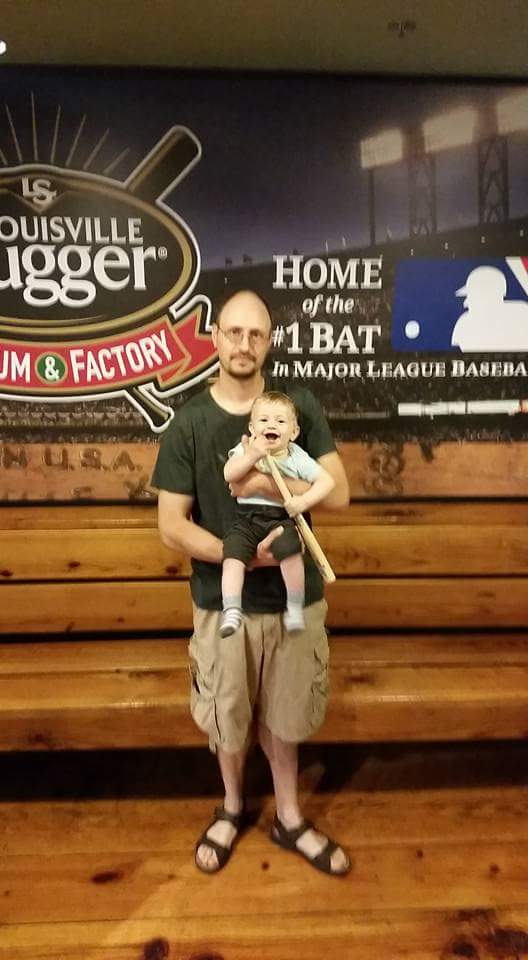
Me and my Lil' Slugger
Since the days of my youth, I have enjoyed baseball. It hearkens to an older time that valued skill and patience. Anyone who has handled a bat know about Louisville Slugger bats; they are one of the top names in a short list of manufacturers. We visited this iconic business with its Guinness World Record breaking baseball bat leaning outside the front door and learned about baseball, how bats are made, and how they have changed over the years. I even managed to whack a few balls in their batting cages using Derek Jeter's bat. Across the hall was a traveling exhibit of Ripley's Believe It Or Not. Louisville itself is an interesting town that straddles traditional and contemporary, homey and trendy, and is a great place to go visit.

The history of Kentucky is long. Pioneers had been coming through the Cumberland Gap since before the American Revolution. The pioneer life is marked across this land in various forts and village settlements. Daniel Boone and others made their careers on coming though the Gap and discovering, exploring, and settling this land and the people in turn honor them. The sons and daughters of those settlers reached further and further west as they filled in the land. It is this rural influence and setting that would later birth a new form of musical expression that took its name from the nickname of this state, Bluegrass. Westward settling came in earnest after the Revolution. The Lincolns settled here just south of Elizabethtown, and gave birth to a son, Abraham, who would become the 16th President. His birthplace in Hodgenville is where I had the good fortune to work, learn, and practice my trade of Historical Interpretation as a first year seasonal Park Guide with the National Park Service. It was an honor to be here for the Centennial year of the Park Service and be a part on this very special occasion. In spite of frustrations and struggles, it had its great moments as well. I will miss the folks there tremendously as I transition to a new position in a familiar setting - Fort Scott, Kansas!

Known locally as "Ranger Ryan"at
Abraham Lincoln Birthplace National Historic
Park in Hodgenville, KY
In retrospect, a place is defined by its people, but also defined by the heritage those people have through their collective experience. It is a mix of things that are difficult to pull apart from each other. It's not necessarily the individual ingredients of the stew that make it delicious, but the parts working in concert. All the things I have mentioned in this post make up Kentucky and my Kentucky experience, and no one part singularly defined it. It is rather the groups of these experiences, the places, the people, and the time spent that makes Kentucky different and a wonderful place to call "My Old Kentucky Home".

Saturday, March 25, 2017

Creating an Interpretive Program - Part 6 Alternatives featuring Interpreting for Park Visitors by William J. Lewis

When I first thought of putting together a set that resulted in the Creating a Program series, I had taken a moment to look around at other materials in program creation. There is more than one way to make a program. A book by William J. Lewis was brought to my attention called Interpreting for Park Visitors. It was a case of not judging a book by the cover as it seemed that this book would be superficial and not very helpful. The actual cover had cutesy animals gathered around a plump, pink, baby-thing in a Ranger hat. I admit I dismissed it and went on with the Interpretive Process Model of program creation. With the conclusion of the Creating a Program series, I picked it up for some career enrichment reading on a flight to California I made recently and it turned out to be a worthwhile after all. Rather than being superficial, it was more lighthearted guidance with another era. While Tilden wrote for his time, Lewis wrote for his; Tilden for the 1950s, Lewis for the late 1970s into 1980s. This post was initially going to be a book review but with the end of the Creating a Program and the renewed personal interest in this book, I decided to make it part of the series as an alternative means of program creation to highlight that there is no one way to create a program.

Interpreting for Park Visitors by William Lewis is designed to be an introduction to interpreting for the total beginner. It is likely that in that day and age, that interpretive courses were not available and standards of qualifications for being a National Park Ranger were much lower than they are now. It describes what interpretation is and how it is done without getting too deep into Tilden's books. The first part deals with what an interpreter is and what they do. Part Two explains the basic principles of interpretation discussing the roles of the visitor, the interpreter, and the Park (which you can adjust for your own location, of course). The second chapter lays out the goals of interpretation and third details the primary elements of interpretation. The third part brings specific application of primary elements of interpretation into focus. Chapter 4 explains basics like giving information at an information booth, such as orientation in a Visitor Center or roving out in the area. In Chapter 5 talks are the main idea explored in various settings. The next chapter looks closely at walks, hikes, and tours, which are basically like a talk but with some movement involved. After that came a chapter on "special considerations" that include location considerations, accessibility and ability preparedness, age considerations, language and cultural barriers. A chapter on self-evaluation is included and followed by more resources.

The part that will concern the reader regarding program creation is in Chapter 3 under the subtitle, Organization. This came as a surprise since the opening subtitle was on involvement of the public in a program then the text suddenly went into planning of a program. In this regard, I think the sequence of the book is out of order, since one should plan to involve the visitor but that should be organized first. "Picking a Topic" is the first subheading under organization. The topic is meant to be broad but keeping the audience involved and the significance of the site. It mentions that sometimes the topic will be picked for you by a supervisor or you may be free to make up whatever you would like to explore. The topic is then tempered by the Theme. Again, theme is more like a message or a thesis than a topic. Under Lewis' guidance a theme should:

  • be stated in a short, simple, and complete sentence.
  • contain only one idea
  • reveal the overall purpose of the presentation
  • be specific and
  • be interesting and as motivational in wording as possible


Having selected a theme, the presentation program becomes about developing that theme. Lewis suggests setting up an outline like a formal paper:
I. Introduction
II. Theme
III. Theme Development
A. Interpretive Main Heading 1
i. Supporting point 1
ii. Supporting point 2
B. Main Heading 2
i. etc.
iii. etc.
C. Main Heading 3
i. etc.
ii. etc.
iii. etc.
IV. Conclusion

The Main Headings will be a major practical part of the program, or the subthemes of the Interpretive Process Model that I describe previously. The supporting points make up the talking points of the program. All of this is the framework or the skeleton of the program that still needs further development. With this framework in place then the decision must be made as to what kind of arrangement the program needs to take place, such as a topical, chronological, climatic, spatial, or process arrangement.

The introduction is important because it will set the tone of your time with the visitors. According to Lewis an introduction consists of creating a favorable atmosphere, an aroused interest in the subject, and a clarified purpose of your presentation. He goes into further details into how these three can be achieved but with some imagination, you can think of a few ideas too. The conclusion can basically be a summary of the main points and theme. He suggests using a strong and memorable last sentence to create a lasting impression on the visitor. On an interesting note, he also recommends not weakening this impact by taking questions, thanking the visitors for coming, or for their attention at the end.

For the main body of program Lewis makes some suggestions for what we would identify as interpretive techniques. This support for the main points comes from accurate and factual information that comes from research and is probably the most important and practical thing that can be done in a program. But how this is done s described in a few ways. He cites using examples and related stories, quotes and citation, compare and contrast, and visual aids to help develop the main points. He also emphasizes the use of language in understanding, especially in transitioning from point to point to form a more cohesive narrative. He defines a good transition as a summary of the preceding idea, an establishment of the relationship of this idea to a new one, and a preview of the new idea. He also wants his readers to think more deeply about the words they use so that they are more understandable by all visitors, using concrete words that evoke imagery, and speaking informally, rather than from a prepared text. Following the use of language naturally arises a need to discuss delivery. This includes verbal and nonverbal cues such as being enthusiastic, physically direct, self-assured, and being friendly and approachable. These and more are important things to consider when creating a program.

Interpreting for Park Visitors is much more than a program creation book as indicated nearly in the beginning. It goes into much greater detail than related here and would be a gentle introduction to interpretation for a person interested in becoming an interpreter. There are many ways to create a program. I have demonstrated two methods in this series and hope that they have been helpful in helping the interpreter create better programs. One of the glaring deficiencies that I have left out of this series are the Interpreter's Toolbox: techniques and methods of interpretation. They are the ways in which the interpreter helps make information useful beyond narrative (and narrative is a interpretive technique!). With the conclusion of the Creating an Interpretive Program series, I am launching a whole new series based on providing the interpreter with more tools to put in the tool box of interpretive technique repertoire and a description on how to use with pros and cons of each method. Look for it next month!

Tuesday, February 7, 2017

Creating an Interpretive program - Part 5: Sequence and Logistics

At long last we have crafted a program from the ground up. First, we selected our tangible, intangible, and universal resources, and we ascertained our audience. Next, we crafted a message we wanted to give the audience and made sure it was significant accounting for a Primary Interpretive Message that was made up of subthemes. Then, we connected the subtheme to the visitors with an interpretive technique that explains the significance of the site and allows the visitors to have their own intellectual and emotional connection to the resource. What then remains? In this installment of Creating an Interpretive Program series the finishing touches get applied: the sequence and logistics of a program. While this may not be terrible exciting, they are important to make a basic program into a great program.

Have a place to start
To review, the practical end of the programming is in the techniques that illustrate subthemes as part of an overall interpretive message. The techniques themselves are not the program; they are things that draw attention to the narrative (the message), but by themselves are not connected but only in topic. This is the time to craft the aspects of the program that the visitor will experience and decide the sequence in which you will run the program.

Here are some things to consider in sequencing a program:

  • The Primary Interpretive Message is like a story, so what part of the story will you start with first? This is the sequence. 
  • What subtheme makes sense to start with first, second, third, etc.?
  • Should you start in the chronological beginning? 
  • Will you start at the end and work your way through to the chronological beginning? 
  • Will you start with what is directly in front of you? 
  • Would a topical tour be a better option than a chronological one? 

All of this is up to you. As you engage in your program you must also think of how you wrap up subtheme 1 before moving onto subtheme 2. Abruptly ending one and starting another is a clumsy way of running a program, so work on transitioning from one to the other so you can continue to develop the big interpretive message into an idea to be explored together. This can be done by briefly introducing the new topic before you launch into it, or creating a sense of mystery before the new topic, asking a question to consider that pertains to it.

Bolts! They hold things together, small
but critical if you don't have them
Of course, there is going to be some nuts-and-bolts things to look over first, as previously hinted, and some questions to consider.
  • Knowing where to start or have the program is essential. What time will the program begin? Is there any set up needed? How long would it take to get it completed? 
  • How often will this program repeat? Is it one-and-done? Weekly? Hourly?  
  • Will it be hot, or sunny with the sun in their eyes? 
  • Can the program be moved indoors if it rains?
  • Giving an introduction is great as it gives you a chance to introduce yourself as well as the program and any other instructions as needed, such as safety concerns, mobility issues, or listening problems. 
  • How long does the program last? 
  • Is there any set-up or take down that is necessary and can you do it by yourself or do you need help? 
  • How does the program end? The old joke is that every good tour ends in the gift shop has a bit of truth to it.


Nuts go with bolts, but these are the
wrong kind of nuts, make sure that
your program components support
each other!
With these things in place, the script becoming the next thing that must be tackled. Up until this point all of your writing has been in the realm of theoretical; now we must turn that theory and planning into action words to speak with visitors. The theoretical writing will help you form an outline which is then used to create the narrative of the program. Speaking the written word aloud will help with flow and catch any jagged edges and dangling thoughts and cut out all the extra theoretical stuff that get in the way or bore visitors while helping you remember what to say. Generally speaking, a detailed outline of text is about a minute of speaking. Basically it is a read-through practice that will help commit some of your program to memory and start cementing what you will actually say. This is followed with more practice.
Practicing in front of a mirror can be helpful. A dry erase marker can even be used to make more notes
A physical walk through will help create pacing and will help turn over some logistical errors and make for a better experience for the visitor. Practice, practice practice! Soon it will be ready to start the program with some visitors. Having a peer or supervisor observe you will help catch some things that you have missed and be ready to receive constructive criticism and apply those observations and suggestions.

Thursday, January 12, 2017

Creating an Interpretive program - Part 4: Making Connections

An example: a live demonstration of a team of draught horses
in harness would be a good technique of illustrating a subtheme
of transportation methods that in turn serve to highlight how life 
has changed on a farm over the years.
This month's topic is building connections, in particular, the connection of the Message to the visitor. This is done by using interpretive techniques, also called methods or services. The methods provide opportunities for visitors to grasp the message from different angles using different techniques to illustrate the subthemes and the Primary Interpretive Message that make up the message.
To review: Primary Interpretive Messages come from resource significance. They are over-arching and broad, and often are told as stories. Story is a powerful vehicle to convey meaning as it is central to nearly every society. It is the very basis of Interpretation; from start, to middle, to the end, and on to the gift store. Crafting the Primary Interpretive Message as a story is crucial to program creation, so take care in making one. The subthemes connect the Primary Interpretive Message to the methods that will be examined shortly but are also derived from the resource's significance. They are in narrow scope that support the message. Think of them as examples of the main argument or using parts to describe the whole. Out of the subtheme comes the methods in which you make the connection with the visitor. To be honest, this is the fun part because this will be where you can be creative with what you do with your visitors, like demonstration, role-play, or participation, but also simpler things like humor, story-telling, facilitated questioning, and others. However, going into detail of the Interpreter's Toolbox is not the point of this month's post, but to talk about how techniques are used to illustrate the story and tell your message effectively is.

This also takes some crafting and some evaluation of the resource, as not all interpretive techniques are right for using; some will be more effective than others in one situation but not in another, and too much of the same thing is boring. With this in mind, take some time evaluating what technique works best for the situation to present the resource in its best light. Overloading the visitors with point after point, subtheme after subtheme, in a dense wall of information is not going to help them; do no more than five and keep it simple. To be relevant you also must allow opportunities for the visitors to make their own emotional and intellectual connections to the resource. The connections do not have to be simultaneous; aim for a intellectual connection in one subtheme and technique and an emotional one on the next. Managing to get two into a connection is great too, but there must be an evaluation of whether a method is good to use or something else needs to be changed.

Here is an example to coincide with last month's example of black troops raised at Fort Scott. Since we are working not in person but over a blog, I have ready use of the YouTube Videos to use as a method to highlight a subtheme. Videos are hard to incorporate while doing a program in person, since they use audio and visual media that might be unavailable, broken, or there may not be enough room where the presentation is being given. Could displaying it on a tablet be appropriate if the group is small? What if it is a large group? These are issues to also be considered. Provided in the link below is the opening sequence from Steven Spielberg's 2012 film Lincoln. The point I want to make by showing the clip is to highlight the 2nd Kansas Colored Regiment in battle, the the public eye, and potential impact on history. First, the clip is too long. I would edit it, but it's not my video. Is it worth trying to edit it for my purposes? Is that legal? It's rather violent for younger audience; will that be a problem? These are some of the things that must be addressed before implementation. If I had the bright idea to show this without first evaluating it, it could possibly be a disaster, or at best, a great interpretive tool, if I used it right.
Making an intellectual connection with a resource might sound vague. What does that look like? Some ideas as to what an intellectual connection might be would be to provoke insight, discovery, curiosity, and recognition of patterns and relationships, i.e., getting an audience member to say, "I never thought of it like that!" Emotional connections are harder, at least for me, and include wonder, sympathy, concern, grief, and so much more. Interpretation is to provoke, which is more of an emotional response than a intellectual one, and as such is probably the more important than the two. However, both should be stimulated.

"Some of us was in the 2nd Kansas Colored, we fought the
Reb[el]s at Jenkin's Ferry last April just after they killed every
Negro soldier they captured at Poison Springs. So at Jenkin's
Ferry, we decided we warn't takin' no Rebs prisoner..."
- "Pvt. Harold Green" from Spielberg's Lincoln
Going back to the clip, what are the intellectual connections that can be made if using this clip for interpretive purposes? Knowledge and understanding, for example. "Aha, I just learned about the 2nd Kansas Colored; they were first mustered in at Fort Scott, the second regiment of black men to join. It looks like they also participated in the assault on Fort Fisher as part of the USCT." "Did this interaction of Lincoln and these troops actually take place or was it done for the film?" - an example of curiosity. If I chose to lead with this clip as an introduction to the black regiments raised at Fort Scott I might make a cliffhanger of this scene and save it toward the end of my tour to provide both an intellectual (information) and emotional (dramatic release) connection. Emotionally, the clip shows that war is ugly, that there was injustice, but ultimately hope in the Union cause and the cause of freedom as the last lines of the Gettysburg Address were spoken back to Abraham Lincoln by a black soldier. So is this method an excellent choice to use with visitors in a program? In my opinion, no, unless I can edit it. It might be better to investigate another method to reach the visitor, like an excerpt of the script or Living History, or an image, but including any of these would lose a lot of emotional impact. I included it because my medium is different; I am communicating using the internet where I can use video much more easily to illustrate points than if I were in person.

Making people make connections destroys interpretation. Telling people what to think is not interpretation, so make sure that you do not make connections for them in a such ham-fisted manner. Picking the right method brings the visitor in connection with that subtheme, and in turn, to the Primary Interpretive Message.  It is more like guidance than instruction. Discovery for oneself with some guidance is the goal.

Saturday, December 24, 2016

Creating an Interpretive Program - Part 3: The Message

In this third installment of Creating an Interpretive Program, the parts discussed previously are coming together to form the message, sometimes called the theme. However, while many agencies and organizations use "theme", they tend to confuse the issue of what "theme" means since there are many meanings of the word theme. The interpretation of theme that this post will use is a theme in the sense of a "message" or a thesis, rather than theme as a topic. This is crucial because the message of a program is very different than the topic of a program. It is an incredibly crucial step in the creative process, but it is very challenging to write about and provide pictures for, so try to bear up and endure.

The job of the interpreter is to connect visitors to the resources in a meaningful way, so the interpreters must provide the opportunity for the visiting public to explore the ideas and significant aspects of the resource in order to make sense of them in their own personal way. Not all visitors will come away with the exact same experience, and if they come away with the exact same experience, they did not really have an interpretive experience but a lesson. Remember, Tilden's sixth principle is not to instruct but to provoke and so by telling them what they should know, think, or feel, that it is not real interpretation. So it starts with the significance of the resources themselves.

Places set aside for the enjoyment, learning, or appreciation for visitors will inherently have some significance or value. The degree of significance is dependent on who or what administers it. Is it a national level significance? A national level entity probably administers it. Same applies to state or local locations. Private holdings really kind of depend. For example, George Washington's home, Mount Vernon, is a run by private association but has arguably a national level of significance. We attach meanings to places, people, and things and the significance comes from how powerful, profound, or wide reaching the meanings are for these things. The significance can be found in the intangible meanings and in their tangible meanings as well and generally have a wide appeal. The significance of the tangible resource can be put into statements that are part of the flow and process of making a message for your visitors. According to Richard Kohen and Kim Sikoryak's book on interpretation, "Meaningful Interpretation," the significance statements "are factual statements that include enough context to make them meaningful, summarizing the importance of these resources to our natural and cultural heritage" and is the first step in creating a interpretive message. Significance answers the question, "So what? Why does any of this matter?" In high school, we did ID/Sigs as homework and doing this following exercise may be helpful to creating and isolating significance statements. First we ID'd the resource and then described it. Then the significance of this resource was described. Here is one example using a real resource, Fort Scott in Kansas, where I worked for a season. One possibility of a significance statement might be "The first black soldiers to fight for the Union during the Civil War were first enlisted at Fort Scott".

The interpretive message has two levels: primary messages and sub-themes. The primary are the overarching stories about the resources. Sub-themes are the smaller-scale stories within and make up the primary. The narrower scope encourages the exploration of specific ideas in greater depth. Sub-themes are the specific themes used to develop individual interpretive services or techniques.

Characteristics common to all primary themes and sub-themes include:
  • Each is based on the significance of resources (arrows in above image)
  • Each is the essence of a story used to help visitors explore the multiple significant facets of resources.
  • Each connects resources to larger ideas, meanings, beliefs, and values.
  • Each is best stated as a single sentence that includes tangible and intangible elements. Single sentence structure forces theme writers to focus their ideas. An interpretive theme is never stated as a topic. While topics can be useful in organizing a body of work, topics alone do not provide sufficient interpretive focus. Since topics are written in one or several words such as geology, southwest history, etc, their meanings are too ambiguous to be useful as themes. Structuring themes as complete sentences ensures a more coherent development of related ideas.
  • Each incorporates universal concepts: big ideas that mean something to everyone, though not the same thing to everyone. The use of universal concepts enables a wide and diverse range of people to find personal paths to connection to the stories of the place and its resources.
  • Each provides opportunities for people to explore the meanings of the place and its resources, without telling people what resources should mean to them. 
An example of the Primary Interpretive Message might go like this (still using Fort Scott as an example): The black soldiers recruited at Fort Scott were the first of any state in the Union to fight for their freedom. The universal concept could be struggle for freedom. A subtheme might be the enthusiastic black communities in Kansas that filled not one regiment but two. An interpretive service or technique for illustrating this would be a map that described free black communities in Kansas or a newspaper from such a community advertising for recruits.


With all that in mind, a single statement sentence that summarizes and articulates the interpreter wants to develop will be the core around which the interpretive program will be built around. It is based upon the significance of the resource and guides the development and the ultimate presentation of the program. It should include both intangible and universal connections. Since there are a lot of things to consider in making a message statement, it will not be easy to do, nor will it come quickly. This is not a 5 minute exercise on a single draft. This is not a last minute job. Creating a message takes time, crafting, editing, revising, probably some collaboration, and re-doing if need be. There is a lot to consider when making a message so take the time to do it right and keep checking to see that it makes tangible, intangible, and universal connections as well as fit the Primary Message and Subtheme characteristics. The message must also be relevant as anything that is not will not be as powerful. Since some of the ideas can be quite complex, try keeping to one idea at a time when constructing a message as this will quickly complicate the overall message that will be delivered.
On Oct 29, 1862, 240 black troops from the 1st Kansas Colored Infantry were sent to rout out bushwhackers, Confederate guerrillas, in Bates County, Missouri at a place called Island Mound and according to reports fought valiantly. Up until then, black soldiers were used for menial labor, even though they enlisted as soldiers, but their courage and ferocity turned the opinions against using black troops in combat as news about the success of the skirmish spread.

Previously, the success or failure of an interpretive program used to be measured by how well visitors could remember and state the theme of the program. This lead to programs that were designed to be easily remembered with a recurring theme statement that made it easy for visitors to recall when evaluated. By doing this, the message became a take home lesson that failed to create a personal meaning for the visitors since they were told what and why the resource was significant.

I'm not so brilliant to come up with all of this on my own, I had some help sorting this topic from this website and will go into greater detail than I can spend time doing on this blog:
 https://www.nps.gov/parkhistory/online_books/eastern/meaningful_interpretation/mi2c.htm


Wednesday, November 23, 2016

Creating an Interpretive Program - Part 2: Knowing the Audience

In this second installment of the Creating an Interpretive Program using the Interpretive Process Model as the guide, the focus is on the importance of considering the audience. After all, no program is created with the intention of not being used; it is made to deliver to real people. The audience is listening and it wants to hear from you.

Your audience is going to be different every time, so be
flexible with your material and take into account 
different interests without over-planning.
When creating an interpretive program, an easy mistake to make is to assume the audience is just like you and is interested in everything that you are. Believe it or not, the people in the audience are different than you and have different perspectives, opinions, and interests. One thing in your favor is that they are all here, right in front of you, and so that means that some of them must be interested in hearing what you have to say or seeing what you have to do. On one hand, give them what they want. If you are at a historical house, give them the tour. If it is a big fossil bed, talk to them about the fossils. On the other hand, they may be a captive audience or do not know exactly why they are there, so your interest and excitement in what you are doing or saying can be infectious. The method that works for both types of audience is to be both informative and a little persuasive.

The elusive
"Average Visitor"?
Another easy mistake is to write a program aimed at a mythical creature called "The Average Visitor". This creature does not exist. It happens when the program is written to anyone, and by doing so, is directed at no one. Anywhere you go, whether to an interpretive site, the grocery store, or the bank, everyone there is going to be a little bit different. Over time, some noticeable characters and features of the visitors begin to stand out. Does your location get a lot of international tourists? From what countries? Children on field trips? Snowbirds? Families on vacations? Mostly men, women, boys, or girls? These are only some of the characteristics that should be taken into consideration. Giving an interpretive program to a group of international tourists is greatly different than families on vacation, but sometimes they are in the same group! Flexibility is key, but knowing your audience gives range to that flexibility.

As a result, it can also be taken in the extreme opposite end. Creating the same program with so many variations for every single demographic represented at the site is too much. Your time is too precious to write out all these specific programs. It is more akin to making appropriate emphasis where most effective while sticking to the script and some variations on a theme. For example, if an international tourist group has a translator, the same program can be given in simplified terms and broken into manageable chunks so the translator has time to quickly understand and then translate the material. Another example would be using simpler language for children and less complicated concepts.

"C'mon man, not even Sasquatch believes in the 'Average
Visitor' "
If you are new to a site, ask around and get a feel for what kinds of people visit the site. Talk to the visitors and get to know them before you create a program and see what interests them. Some general questions to ask visitors during this phase of program creation are aimed at gathering information and include, "What brought you here today?" and "What does this resource mean to you?". These questions are seeking something of value for themselves and a personal sense of what the place means.

December's edition of this blog will be the next step in the Interpretive Process model, the theme statement.

Thursday, October 27, 2016

Creating an Interpretive Program - Part 1: Tangibles, Intangibles, and Universals

For two years this blog has existed with a fair deal of success, however, it as yet has not had a post on how to create an interpretive program. Perhaps it is myopic or trying too hard or another lesson in making assumptions. Aspects of programs have been identified, the methods discussed, the concepts criticized, and the results analyzed, but no step by step explanation has been given of how to actually create a program, from either a talk, activity, pamphlet, or multimedia presentation, excepting creating a written interpretive piece. So, this post begins a series on creating of a program and the essential elements needed to create a effective interpretive program.

Tangible: Fur trapper. Using a beaver pelt (a tangible) to
support a talk about the fur trapper.
One method for creating an interpretive program is following the Interpretive Process Model which is like a flow chart of decisions that help define what the program is about and how it is organized. It begins basically with the concept of tangibles, intangibles, and universals. Tangibles, intangibles, and universals and such were brought up in the interpretive writing post, but I did not go into detail as to what they are about.

The first step is to select a tangible that you, the interpreter, want the visitor to care about. A tangible is anything concrete: animal (dead or alive), vegetable (dead or alive), mineral, made object, place, or sometimes an event. It is something that the visitor can relate to in a sensory fashion - touching, seeing, hearing, sometimes smelling, rarely tasting. This is generally something that can be experienced on or with the intended program. There can also be multiple tangibles but there will usually be at least one that is most symbolic of the choices. More than one can get tricky and difficult, but basic programs will have at least one that acts as the center of what the program is about.

It's hard to take a picture of
intangibles and universals, so here
is a photo of the universe.
Intangibles are little more tricky since they are harder to grasp, figuratively and literally. They are more symbolic or idea based. Examples of intangibles are migration, slavery, freedom, education, and rejection. You cannot hold migration, but you can touch a wagon. You cannot hold slavery, but you can walk through slave quarters. Intangible things spring from the tangible. A single tangible can have many intangible meanings. Stringing multiple tangibles to their collective intangible to focus meanings is the basis of the craft of interpretation and from that collection should point to a universal.

A universal is just that; it is something that we all experience and find some meaning from, regardless of who we are, but each view a little differently. These are also intangible by nature and are very broad in category such as life, death, hunger, struggle, survival, and love. A universal should then reconnect to the visitor on that level for they should also experience these as they are universal to all. They connect to both the tangible and intangible to the visitor so that they can examine their own intellectual and emotional understandings and find meaning in their visit.

A collection with hardly any meaning, from this blog post 
Ignoring one of these three elements makes the interpretive program weak. A program talking about ideas and ideals without anything solid is a philosophy lecture. A program with no intangibles is a collection of things without meaning. A program with tangibles and intangibles but no universals is mildly amusing but left wanting in meaning as well; it fails to answer the question, "So why should I care?"
So for the first step of the Interpretive Process Model is to select a tangible that you want the visitor to care about. You want them to care. You want them to make not only an intellectual connection but an emotional one, because people will value and protect that which they care about. If making people realize that a hypothetical endangered flower only blooms here and how crucial it is to the vista and the food web and how that ultimately affects them, they will help to protect it, for example. It is the job of the interpreter to interpret the selected tangible's intangible message to make a universal connection that reveals the value in the tangible so that all people can agree it needs to be valued and protected from this point on. Because of this, the tangible must be something that has an intangible meaning.

Tangible: Wagons, Cars, Intangible: Migration,
 problem solving, comparison
Universal: Problem solving, improvement
Since tangibles can have all sorts of meanings, the interpreter must select an intangible meaning to
follow up on it as the direction of the program. Once the direction of the intangible message is
determined, other tangibles can be used to help reinforce that message. Are there other tangibles at your disposal that support your program? The more tangibles there are that support the intangible message, the more complicated the program. Throughout the program, the universal connection is subtly reinforced, so take some time to make sure that the message is something everyone gets.

Every great program starts with excellent planning. Using the Interpretive Process Model to plan the program helps identify all the essential elements of great interpretation. This first installment on program creation will be followed up by developing themes based on your selections made from this session, so stay tuned next month for Part 2 of Creating a Program series.