Thursday, January 1, 2015

Site Visit: John Deere Tractor & Engine Museum

This December a new museum opened in Waterloo, Iowa: the John Deere Tractor & Engine Museum.
Waterloo, IA
I had driven past it for about a month on the way to and from work. It looked new but never looked like it was in operation, until I saw in the newspaper that it had finally opened. Before I launch into the museum, you should have some background about Waterloo before you can appreciate the museum more fully. Waterloo had first been settled in 1845 as Prairie Rapids Crossing, but when petitioning for the Post Office in 1851, one of the founding fathers of the town liked the name"Waterloo" and put it as the name of the location of the Post Office and the town eventually came to be known as Waterloo. The latter part of the 19th century was a busy time for Waterloo with the establishment of the Waterloo Gasoline Traction Engine Company followed by the Rath (meat) Packing Company and the Illinois Central Railroad. Waterloo was dubbed the "Factory City of Iowa". Speeding through the 20th century, the town was doing well for itself until the Rath Packing Co. ceased operations in 1985 and the John Deere Company had some layoffs not too long afterward. The town today is post-industrial in nature and retains its blue collar neighborhood feeling.

However, the story with the museum goes back to the Waterloo Gasoline Traction Engine Company mentioned earlier. I know a thing or two about farming, thanks to the Living History Farms and from working in the farm implement store, but the rise of modern farming implements, their names and uses, are foreign to me (so if I goof on something, don't get crazy on me). So, manual and animal power can only get you so far. Arms get tired, animals need rest, and with more interesting and useful implements comes a need for more power. In 1892 John Froelich invented the first practical gasoline
powered contraption we know today as a tractor. He centered his operations in Waterloo, using the nearby Cedar River for energy as the Waterloo Gasoline Traction Engine Company. By 1914, the company was producing the most popular tractor on the market, the Waterloo Boy. The John Deere Company, meanwhile, was successful in farming tools but wanted to get into the tractor market and decided to simply to buy the best company after their own attempts to break into the tractor market failed. Overnight, the John Deere Company became the industry leader. Since that purchase, John Deere has had a presence in Waterloo.

The John Deere Tractor Museum documents the life before tractors, the invention of the tractor, the acquisition of the Waterloo Gasoline Traction Engine Company, and how the Deere Company weathered the challenges of the 20th century and how Deere tractors are being used both today and into the future of farming.
The lobby for the Museum

Rather than synthesize what I learned from the museum and interpret the history, the purpose of the site visit was to look at how the John Deere Tractor & Engine museum tells their story, rather than
what their story was. Because I'm not a tractor guy and I have zero knowledge of tractors (If you are, great! If I don't note a tractor as being a 1947 Model X, I apologize), I thought it was an excellent opportunity to see how well their told their story and maybe understand something about it.

My wife trying the plow interactive display
My initial reaction to the building is that it looks new, and the refurbished tractors in front and in the lobby looked sparkling and fresh. It was $8 admission for an adult and less for children, students,
military, seniors, and Deere Co. employees and includes a 15 minute video presentation that runs quarterly round the clock. The pre-tractor section of the museum was my favorite, because this is my world. Lots of wood and "old-timey" looking mock up set design. There was lots of touch and try. For example, there was a demonstration area where you could put hand to plow as the mechanical plow bumps and jimmys and you have to keep the plow pointed straight. If you are not straight, a red light flashes on the side you need to correct. It was interactive and fun, but as I smugly told my wife, you aren't having to wrangle draft animals and steer with the lines and trying to keep the plow straight. However, the liability to make it as real as it gets would be too great. Nevertheless, it was a great piece to interact with. Another interactive piece used weights to simulate how much human energy you would need to create a single horse power. It was like an exercise cable pulley
Feel the burn! I mean, have fun learning about horsepower
machine and I joked that I could do some tricep curls. But unlike the gym, if you drop the bar, it doesn't crash into the other weights like that jerk does at the end of his reps, but slowly descends back to the start on a winch system (thankfully!).

The panel on early tractors
Towards the end of that exhibit room, they have a couple interpretive panels on John Froelich and his traction invention. I was glad they had it, but felt that because he invented tractors, that there could have been more of an emphasis on this, but I feel that John Deere wanted you to get from the archaic history stuff into the newer modern era of tractors most of the public might be familiar with. It is their museum after all. The traction machine was a large complicated looking machine, and a wandering Guest Services staff member remarked that it was started from a shotgun shell. I asked them where it was inserted and they didn't know. I don't remember if a shotgun shell start up was in the panels I read either. So, minus some points for that. Along with some of the flat panels were push button audio tapes of notable people speaking in character about their role, which helped break up the flat panel reading monotony.

Lean Green Machine
The next room was bright and modern and in the center was a Waterloo Boy tractor. This was given centerpiece attention, and rightly so, for being popular and one of the reasons for Deere purchasing the Waterloo Gasoline Traction Engine Company. Along the wall were more interpretive panels describing the process the Deere Company took in arriving at the point of getting into the tractor
business. All other rooms went on to describe Deere's contributions to the war efforts and life here at the factory. There were more interactive opportunities as well. Touch screen displays allowed a visitor to make decisions about designing tractors, whether to change engine configuration or what kind of wheel placement would work. I wanted more of a futuristic look rather than classic and after I submitted my design, it was graded according to what decisions were made historically regarding my design. The remains of the rooms were 3 sided walls with the back of the wall opening into a showroom of all the tractors made by Deere at this location.

The "Showroom" was open and had different models scattered around. As far as I know, all the tractors were rebuilt or refurbished models by private individuals and almost all were given a fresh
The "Showroom"
coat of paint. All except one, and naturally it drew my attention. The donor requested that their donation retain "its work clothes", meaning that it shouldn't get a new paint job but to be in its natural state as if it were to be in an old tool shed somewhere, ready for work. I appreciated the gesture by this person who donated because everything on the show room was show room quality, even though they were not collectors items, they were work tools and while they were taken care of, keeping the paint fresh was not on farmer's minds. But as I wandered through bright green and yellow tractor after tractor, I could feel myself reaching a saturation point. This was not my world and I had difficulty relating to it.

Guess the start-up sounds on the left,
the tractor design with clues on the right
If you have or had experience with old tractors, there were a few more interactive opportunities that you would enjoy that might take you back. There was a section near the back that sounded the start up of an engine with the push of a button and could guess which model of tractor it came from. Your answer would be hidden under a pull panel that would reveal the name. I didn't grow up around tractors or learn how to tell what model tractor it is by the start-up and running sounds but if you did, it might be a better section for you than me. It was still interesting to hear. The same is true for the section of grille patterns.

I liked the drafting table as interpretive space idea
There was another designing section that utilized drafting table drawers that
was interesting to look at and younger people could draw their ideal tractor and display it in the museum. By the foundry area I had reached maximum saturation. I don't understand machining or foundry work but I couldn't relate to it and did not really connect with it. The center of the museum was about the factory itself. By picking up a approximately two and half foot water tower and placing on a map that took up the floor, the screen would tell you about the factory and its history.

By the end, a room was dedicated to the tractors that John Deere was producing today and a small enclosed exhibit on the Deere Logo, dealerships, and their brief foray into bicycle manufacturing. Along the wall was a video of where farming might be going in the future with touch screens and smart phone automation connected to the internet and beyond. It was a video with grandpa working farm software that look like it was developed by Tony Stark and was beaming his HUD into a tractor in the field. It was something to think about. By then we had finished and wandered over to the gift shop to look over the John Deere-branded-anything-you-want merchandise.
In the cab

Analysis: This was a very well done museum. Everything is bright, clear, clean, and professional. Some people have done an excellent job with the presentation in getting all ages involved with the exhibits, from youngsters drawing tractors, to older folk remembering the distinctive sound their tractor made when it started up. There are a lot of interactive pieces, which shows that it wishes to engage learners visually, auditorially, and kinetically (seeing, hearing, doing). It engaged me as a historian by exploring many aspects of the pre-tractor life, the development of the Deere company, and its role in defining 20th century farming. The tractors are all immaculately presented (a little too immaculate if you ask me) and exhibits are simply all well done. However, there are some things that were not-so-great. Aside from the expected self promotion, there was a lot of flat paneling, which means a lot of reading. Most people do not take the time to read everything and tend to glance over information, especially if they have read a lot at the beginning and will increasingly just glance at large panel text after a while. Guest Services people were not terribly engaging. "Do you have any questions?" is not an dynamic engagement technique, for example. Some sat on the tractor seat design exhibit and chatted with each other and what appeared to be someone they knew somehow and I didn't get to sit on historic seats. I wasn't sure if they were Deere employees in Guest Services or guides hired for this position in the museum, but my guess is that they are not trained interpreters.
Over all, they generally did well in engaging a person who has little to no background in tractors and had a lot to say about what they did. I would recommend this museum to people who enjoy farm life, tractors, technical mechanics, John Deere fans, and to interpretive exhibit designers. If I were to give it a score based on 1 to 10 I would give it an 8 for being clear, well designed, engaging, interactive, and a good use of my time, but needed some refining in their interpretive staff.


Saturday, November 15, 2014

Lessons Learned

Sincere apologies for the long silence; I have had a month of transition that included two simultaneous moves, a frustrating housing search, a nine-hour flight to Germany for a long weekend, terrible sleep and jet-lag but good family fun, another twelve-hour flight back to Los Angeles, another flight to Des Moines with my wife, negotiating housing, moving into a house, a road trip to Chicago for Pre-Service Orientation and back, and starting a new position in a town where I don't know anyone except my wife. So I've been busy and stressed. But I've managed to endure and overcome. Maybe not worth an Oscar-winning screenplay epic, but it was hair-raising nevertheless. I have had the meat of this post ready to go since the middle of October when I was nearly finished with my time at the Living History Farms, but got hung up on the editing and picture selection. In light of the end of the LHF season, I think it is probably a good time to stop and reflect on what I've learned and maybe gain some insights into what that means for how I do interpretive presentations.

Feeding the separator machine
When I originally set out to do a blog, I had intended it to be much more of a daily journal of "Wow, I got to do this today at Living History Farms!" and describe what it was that I was doing. I had never worked on a farm, so everything was new and great and every new day was a new experience that I had to learn and adapt to. It didn't help that I decided to start a blog about these experiences after a few months of working at the farms so it wasn't as new or as exciting as it was at the beginning of the season, which explains the far fewer posts on farming than I would have liked to have posted. As a result, this post will address most of this as a retrospective rather than a fresh look.

Farming is hard work. It requires strength, skill, and knowledge in order to be successful and for the most part, I think I was successful. We describe our work as "9 to 4 farming", meaning on a true farm that you lived on for your livelihood, you would be up before dawn doing chores and asleep not long after dusk, whereas "9 to 4 farming" means I start work after I clock in, well after daybreak and finish the last of my chores about 3:45; a good 3-5 hours before dusk. Not exactly the natural cycle most of America knew during the time periods we represent. Chores are the biggest routines of the farm and they involve caring for the animals.

Harnessing for work
The horses that we have are one-ton hairy equine teenagers. Each have their own distinguishing quirks and attitudes. At first, I had the hardest time telling them apart. But as I got to know them, their traits and descriptions became more noticeable. The Percherons are generally a gentle breed, but the more slack you give on their line, the more room they will take in doing what they want, so cinch up close under their chins and lead. Then they follow you, not their own wills. However, I will tell you when a horse puts up its will, it's better to let them go than get dragged or rope burned.

Cows, like sheep, are ruminants and do not have upper teeth in front, which is why cows "lick" the grass into their mouth rather than bite. Horns can be on both males or females; it depends on the breed. The proper way to milk a cow is to adopt a forefinger-thumb "OK" grip and ripple motion squeeze down the teat to the end with the rest of the fingers. Steers must be trained about 4 years before they are considered "oxen" for driving. Since cattle will eat whatever grass you have, they are ideal for frontier living; with horses, you must supplement their diet with complex carbohydrates. Like all horses, the draft breeds were
introduced to North America about the middle of the 19th century which is another reason why oxen were the preferred draft animal for most of the United States' frontier areas. Oxen are also difficult to steer and take time to comprehend the driver's calls. Cattle like to be rubbed under their chin and behind the ears but not the forehead, the seat of aggression. Herding animals isn't too hard if you have a pretty good idea on how animals react to humans, essentially go right so they go left, left to go right. Never stand or approach an animal in their blind spot or they can kick.

Most of the animals, like the horses, cows, and pigs must be fed in the morning, and again in the evening with the chickens and ducks. All of the water must be refilled, even if they immediately knock over their water dish after two slurps. Pigs are jerks like that. To riff on Steve Zissou from A Life Aquatic, "Pigs are supposedly intelligent, but I've never seen any evidence of it." More often then not, they are busy trying to find a way out, for no other reason than the joy of escape. Pigs have rings put into their snouts so they don't root and undermine plants and fences. Most of the farms in Iowa were hog or pig farms because they had a higher price per hundredweight. Piglets are also heart-meltingly cute.
Cuteness overload

Picking up Polish chicks
Chickens come in many breeds. My favorite were the Polish varieties (buff laced) and I had great success in training one to eat out of my hand and being content to be touched, held, and propped on a shoulder. People eating duck meat isn't uncommon, so ducks are often raised along with chickens.

Sheep are dumb. I've known this, but now I can say with some authority that sheep are dumb.  They tend to follow whoever has the most original idea, human or sheep. I've seen sheep come galloping in
from an acre away for grain with a sheep call. Sheep are also ruminants and will eat whatever you have, which also makes them great for frontier farming. Sheep are sheared in spring so their coats will not be thick in summer but thick enough by winter. Their woolly coats are spun into wool thread for clothing.

Fall is here!

Maintaining crops is tough too. We had numerous problems with deer, bugs, erring lawnmowers, and rains and the resulting weeds that came up. Corn is prominent throughout the farms here. I was proud that my rows of corn were the nicest looking rows, but they still suffered from the same problems mentioned above. Corn is grown in hills done in checks. In other words, it looks like military grave stones with enough space in between them to always appear in a row, and that is because the space between hills is gone over with a cultivator which is like a set of mini-plows that dig up soil and root out weeds. Corn hills typically have about 4-7 kernels of seed corn with a mix of other plants that help return nutrients that the corn need or plants that will mutually benefit, like string beans to climb up the stalks, and big leafy plants shade out the weeds like squash, pumpkin or watermelon. Corn cobs are saved after the corn has been dried and ground off with and corn sheller and used for a quick, hot heat and excellent for frying. Corn is mostly used for animal feed but must be ground for the chickens to use and ground finer still for corn meal. Hay is a grass; alfalfa, timothy and clover are examples of hay. Grains have heads like wheat, barley, and oats. Most "hay bales" are actually straw bales; straw is the leftovers from threshing, mostly stalks and has little nutritional value for animals and so are used for bedding and insulation, Hay bales are animal feed. Both are baled by awesome machines that have special mechanism that tie them together as they are made. Once hay is cut, it has to dry for a few days before putting it up otherwise wet hay runs the risk of catching fire in the barn. I'm not even joking. Here's some info on it Wet hay can cause barn fires. We harvested hay on the windiest day I can recall. We used a hay rack (a cart) and a hay loader (a large portable elevator that scoops up hay from the windrow) the basic method was to move the hay to the farthest corners first (the driver's side" and slowly start going up until it is too difficult to pick up the hay below you and go to the barn for storage.
Haying against the wind, from LHF's Facebook Page

Preformed by someone who knows how to scythe
At the Implement Dealership in town, I learned a thing or two about farming and tools. Treadmills were used for harnessing animal energy long before electricity and engines started doing the work. Farm tools were originally painted bright colors for marketing purposes, like cars today. Using a scythe sucks; the Grim Reaper carried a primitive lawnmower. The Industrial Revolution set off a spin-off Agricultural Revolution. Although most of the experimentation was done from 1790s-1850s being able to mass produce patented machinery was what made the money and allowed farming to be bigger and faster. Threshing sucks too; it involved beating grain with a staff with a section of rope to a small club. Hay forks are for lifting hay but many other varieties of tools could be used for lifting hay, baled or loose like the hay screw and hay harpoon. In addition to living the life, I have fuller understanding of farming terms, because you reap what you sow.
Having fun!

Over all, it has been a great experience and an adventure I will probably never forget. Thank you all for being a part of it, "You-know-who-you-all-are." I hope to visit again sometime, hopefully before my membership runs out next year. In the meantime, I've accepted a position with the Americorps VISTA program to go up to Waterloo for a year. Just because my job will not be involved in interpretation in any way that I can imagine right now, I will try to continue to publish as time and ability allow.

Thursday, September 25, 2014

Dealing with the public, part 2. The question

It's been a busy couple of weeks since the last post. Travelling and a birthday and getting ready for a new adventure have slowed down the writing frequency. Incidentally, this blog post was finished the day when we had a discussion of questions that drive us crazy in a staff meeting and I listened closely to see if I could garner some more insight into questions the visitors ask and how interpreters respond.

Whoever said,"There are no stupid questions" did not work in historical interpretation, or education in general. We get stupid questions and comments all the time.
"Teacher? Why are you dressed weird?"

At least, that's what we think.

The questions seem stupid to us at first, because we already know the answer and the crowds are simply ignorant.

Now, when I say ignorant, I want to address a negative stigma that we have attached to the word as a society. When I mean ignorant, I am not referring to some sort of prejudicial, misguided, or negative remark. They are making a question or a comment based on their limited or complete lack of knowledge.

They simply do not know.
Let that sink in for a second and think back on how we ask questions. If I knew all about the topic, why would I ask a question?
"Aren't you hot wearing that?"

Since we interpreters know; since we have the experience, training, and extensive knowledge, of course the question is stupid. We already know the answer, partly because we have answered the same question over and over again to the point that we mistakenly think everyone knows. One of my mentors over the years, a man named Steve Rose, made it a point early on in my training as a outdoor education instructor to remind us that it may be our umpteenth time doing or saying something, but it is their first time asking the question. That guidance has served me well over the years.  While others have mentioned similar thoughts, it was his mantra for long weeks over longer times when the fatigue of repetition has set in that kept me from responding harshly

Realizing that it is their first time and they will ask questions that have been answered with the last visitor is a mental exercise in customer service.

Make it a game. How many times can I get asked some variation of the Same Old Question Everyone Asks in a hour? In a day? Can you break that record? Can another interpreter break that record? One way of letting off that steam is the honest introduction,"We get that question a lot out here..." and give them the answer. This is about their experience, not your convenience.
"Teacher? Do you live here?"

Getting back to the interpreters' reaction to the stupid question, our own satisfaction in our knowledge and wisdom has given us a haughty arrogance, although this haughty ignorance can be subliminal and sometimes not perceptible at first. That is why the question is perceived as stupid. It is our own assumption about the very nature of the person who makes the question or comment.

Because they are asking a question, they are revealing their own ignorance in the content of the question. If they knew, they wouldn't ask. Our responsibility is to remove that ignorance by giving a affirming and correct answer delivered in a manner that the questioner can effectively receive. Never make stuff up. The hardest thing as an interpreter is to admit not knowing an answer to a question. It's humbling. If you are working in tandem with a staff member, bring the person with the question to your fellow staff member, introduce them to the knowledgeable staff member and have them repeat the question or rephrase the question. That makes it personal and shows that you are learning together while keeping them involved. Another method for answering when you don't know an answer and admitting you don't know either is trying to reason out an answer. For example, if the question is about a certain tool on the wall and have never seen it demonstrated, work with them and work up a couple ideas about what it is. Is it sharp? Does it have a handle? What could we use it for? The most important thing is to later find out the answer! If you got the question once, you will probably get it again. Hopefully that embarrassment you feel at not having an answer will prompt an earnest search not to be put in this situation again.
"Do you have a question?" "Can I go to the bathroom?"

Then there are these questions, "Is that fire real?" Resist the urge to give sarcastic answers. Especially with children. Children do not have the sophistication to understand sarcasm, not yet anyways. It is rude and patronizing. However, I've wondered what the fascination is with what is 'real' at interpretive sites. Is it because of our technological wizardry that we have blurred the lines of reality? 3D special effects, life-like images, life-like props, Hollywood magic, and the child's own sense of fantasy have led into a lot of the 'reality' questions. The urge for a sarcastic answer also stems from repetition and arrogance.
"Teacher? Is that gun real?"
"Yes"
"Can you shoot me with it?"
"No"

Sometimes you get the silly questions. In my opinion, you can give a straight answer or the occasional silly answer. Reading your audience is key for giving a silly answer, and it isn't always advisable. I was given a silly question the other day: "That's the biggest pig I've ever seen in my whole life! Are they rhino-pigs?" The questioner was a pre-teen girl and her giggly friends. Based on that and a few other observations, I decided that they were being silly, so I felt I could safely give a silly answer in response. "Yes, rhino-pigs are a common animal in North America; they are mostly used by the army, bred for their skills and magic." I said this with a smile. They giggled and moved on before I could give a thoughtful response on pig sizes, so that further cements my observation of silliness; they were interested in making small talk, not the size of pigs. They understood that I was joking. The silly answer is tough to gauge when would be appropriate, which is why I will rarely use it.

In the end, we have to come to the realization that we must have patience with the visitors and to hold back our frustrations at having to answer questions that would be quite frustratingly obvious to us, over and over again. Remember, it's probably their first time, so make a great first impression for them!

Tuesday, September 2, 2014

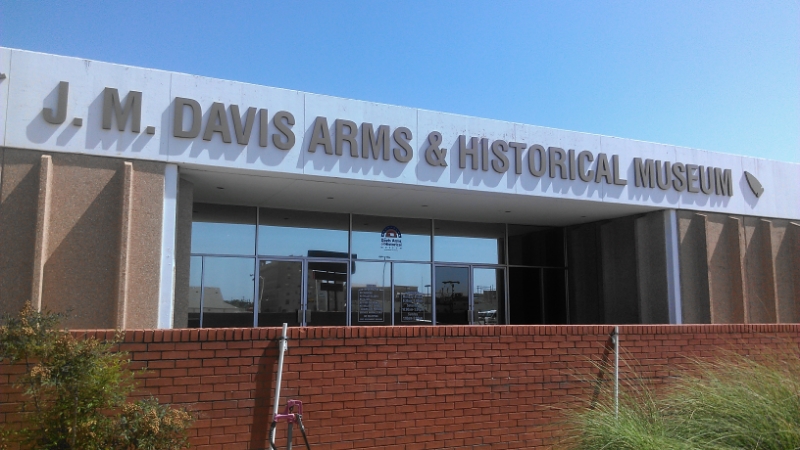
Site Visit: J. M. Davis Arms and Historical Museum

I visited the J. M. Davis Arms and Historical Museum in Claremore, OK with my extended family in the middle of August. They had never been and neither had I. But it was nearby, suggested donation admission, gave us something mutual to do, and probably had air conditioning (which it did). At first blink, it appeared to be a large room with an information desk asking for donations, dispensing information, and sporting a volunteer. A gift shop was nearby for the kitschy Route 66 and John Wayne souvenirs. I was given a hand out sheet which described J.M. Davis' beginning and how the collection came to be and indicated that the tour started to the right (I promptly folded it in quarters and put it away). The collection started with the hotel lobby of the former Mason Hotel that Mr. Davis had purchased and used it to show off his collection of firearms. The "hotel" display initially struck me as the old school museums where the entire collection was on display but with no interpretation to understand what it was I was looking at. There was a case with interpretive placards that had his first and last weapons acquired as well as the oldest, a Chinese hand cannon from the 1200's.

"Gee, that's a lot of guns I don't know anything about!"
But it was the meaningless display of weapons on the wall the gave me a false first impression of a guy who had a lot of things but didn't know what he had, so he put them all together to make some sort of weapon mosaic to adorn the walls. Like a child's collection of sea shells in a shoe box.


Making my way out of the room was the directory of where weapons were. It wasn't very helpful to understanding what I was about to invest my precious time. Immediately to that side was a display on Native American cultures, then a collection of beer steins. It appeared that Mr. Davis collected all sorts of things and they were on display in this museum, as well as a model train set, recruiting posters, saddles, spurs, and boot jacks. It was looking like a child's box of shells indeed.
At least the Native American stuff had some information
about what it was that we were looking at
Then came the guns. From all over the world by manufacturers big and small, machined perfection and homemade or modified, of all shapes, sizes, and functions. The basic feeling was overwhelming hopelessness, like having to find every 1967 penny out of a vault 3 feet deep in pennies. Lines of display cases with a 6in x 4in placard describing the weapon's caliber, country of origin, model, make, serial number if known, where it was made if known and maybe a little blurb about it. Such as "The standard rifle of the US army in WWII". Sometimes it was grouped by conflict, or by manufacturer, or by type all over the building. It was not very well laid out and it seemed that there was a lot of overlap. But the volume of display cases stretched on for quite some ways before suddenly turning to reveal more display cases.
A display on the Enfield rifle, a fairly typical display style for this museum
But if you are into firearms and have the patience and time to appreciate them, boy is this the place for you. You want 4 panels of muzzle loading long arms? How about a whole section of Smith and Wesson? Japanese WWII rifles? There were some interpretive sections where they took the time to highlight certain weapons or people who owned the weapon you see in front of you. But mostly it was like the panel display case above.

 As usual, with most modern weapon displays, I look for "my" weapon. The BAMFiest weapon to exist on sheer looks alone, the Lewis Gun.
Lewis Gun? Check!


I even found the extremely rare 1938 French sub machine gun; not one, but two!
The French only produced 1958 of the MAS-1938 before German
occupation and unknown amount after the war until 1946. The
barrel and the stock are at different angles, which was thought
to aid  in recoil. 

A whole display on notorious weapons and their owners...
In this display they had weapons from Charles "Pretty Boy" Floyd,
Alvin Karpis (bandit), John Wesley Hardin (killer), and
 Bonnie Parker and Clyde Barrow (Bonnie and Clyde, bank robbers)


Text reads: Pancho Villa, Bandit. This gun, a .44 Smith & Wesson Single
Action Revolver was purchased from Pablo Gonzales
by Merle A. Gill in 1933 in El Paso, Texas. Gonzales was a 
former member of Villa's band in 1917. This gun was one of many that
had been carried by Villa. The gun has am 8in barrel and shoots the
.44 "American" cartridge. This same type of gun was found on "Wild Bill"
Hickok when killed in Deadwood, S. Dakota in 1875 by Jack McCall

All manner of weapons were in the collection, including air guns, BB rifles, toys, and Sci-Fi weapons.
Text reads: "Disintegrator" - Buck Rodgers 25th Century.
With 800,000 Buck Rodgers pistols added to BB gun sales,
the company went over the million dollar sales mark in 1934.
Retail price $0.05/ Daisy MFG. CO.
Plymouth, Michigan. (12631)  


My family wanted to see a display that one of the members of their church had loaned for a display
An interpretive display on weapon making

on modern war and they managed to find it. I write managed because of the sheer size of the place made it difficult to find things. The kids were running out of steam and it was about lunch time and we were making it back to the entrance to leave when we found an interpretive display on how weapons were originally made in America. It looks like no one was supposed to be in there to talk to people and it was behind a bunch of display cases and if we had traveled one row over we would have never saw it. Which was a shame, because so much more could be done with it.


For being a "gun museum", 10 out of 10. For being a historical museum, well that can be tricky. Because it did have historical weapons, there was some labeling, there were interpretive areas that explain a weapon's significance. However, there were clear examples of just throwing weapons in a display without much interpretation at all. The interpretive aspects were hard find. I think it comes down to exhibit design. The museum suffered from poor museum design. Long rows of displays, inadequate mapping, inconsistent labeling methods, weird collections like the beer steins detracted from "historical" and "weapons" in the museum. While it could be argued that the steins were historical, it still doesn't fit will with the over all museum display. For those reasons I would give it a 7 out of 10. It's not a total waste of time, but can be overwhelming and frustrating if you are looking for something specific. Enjoy the interpretive placards and exhibits when and where you stumble upon them.


P.S. Can anyone explain to me how a pepperbox works? Does it revolve on an action (like a revolver)or after each firing you have to manually move the a loaded barrel?

Thursday, August 21, 2014

Dealing with the public, part 1. Interpretive Equation


As a historical interpreter, you deal with the public. A lot. Or you should anyways. I have been a Civil War Living Historian for a long time and I find it hard that some of my comrades simply don't want to interact with the public. They will answer questions, sure, but not many are going to get up off their chair and go to talk to a small family unit looking sheepishly at a rifle stack. It is like they are there to camp while the public is there to stare at the 'animals' at the 'zoo'. As mentioned in a previous post, I tend to take my time as a Living Historian seriously enough to see that value of interacting with the public. They want to know more, but sometimes it needs some personal engagement to get them to vocalize in spite of the shyness. If no one will tell them, how will they know? My comrades don't stir, they're "off duty" but I get up and go over to them.


Ryan in tactical position to meet curious visitors who want to know more about rifles.

Go-Go-Gadget Interpretive Equation.


The Interpretive Equation, for the uninitiated but delightfully curious, is a method of interaction with the visiting public. In its long form, it is Knowledge of Audience plus Knowledge of Resource taken together multiplied by Appropriate Techniques, which yields an Interpretive Opportunity. The formulaic notation is (KA + KR) X AT = IO. Starting up to them I'm gathering knowledge of the audience; it appears to be a nuclear family of father, mother, two young sons, and baby in a stroller. The boys are probably most interested in the guns and the bayonets, like most little boys. It is important to note that you shouldn't "dumb it down" for the children, but make it understandable for them. The father may be too. While in transit to their location he ask the boys what the pointy thing on the end is used for; this indicates that he has a level of knowledge of the resource as well. His physique suggests he is not former military, so maybe a war buff. Mother isn't too interested and neither is the baby in the stroller. My guess is that I will probably be talking to the boys mostly. Based on what I observe, that is my basis for the knowledge of the audience I will be working with. If anyone else wanders up to listen to me talk will have to be evaluated on the fly.


I also have knowledge of the resource, in this case, they are looking at the rifle. I've put together a rifle stack for years. I know what makes them stand or fall and which rifle to pick up to demonstrate for the public. I've handled these weapons for years. Re-enactors generally either get a 1861 Springfield rifled musket reproduction or a 1853 Enfield rifled musket. Maybe a handful of 1855 or 1863 Springfields. I have a general idea of effective and maximum ranges, rates of fire, differences, etc. That is my starting point.

Appropriate Techniques can by tricky. I should probably hook them in with what they want. They either want to talk about the rifle or the bayonet based on previous experiences with visitors. Holding the rifle will probably be the highlight. That is an example of participation. Using props is another technique but the opportunity involves a prop so I already have that going for me, although first I should probably demonstrate the rifle; pick it up myself and show the moving parts. They probably won't be interested in a story about the rifles right away. Maybe after a while tell the stories about jamming ball after ball down the muzzle without firing in terror and panic during battle. Using song is probably not appropriate since I don't know any songs about the rifle, it would be awkward, and I don't sing well by myself. But that leads to humor. Humor is great, it relaxes both parties and you can share in something equally. I may make a quip about "boys and their toys" to the mother to bring her in on this too. KA + KN x AT (techniques will likely include prop, demonstration, participation, story).


I greet them and get right to the point. "Would you like to know more about the rifles?" Both boys are excited and affirmative. So I get to a stack of rifles and pick the leaning rifle up. I give it a glance. "This is the 1861 Springfield rifle, one of the many rifles made in the north from the armory in Springfield, Massachusetts." I hold out the rifle for the boys to see first, then the father. But the mother kind of moves in too, so I might not have to work so hard on her after all. "A soldier had to learn to fight with this rifle and learn how carry it." I'm getting ready to talk about how heavy it is and get the boys to feel its weight but the younger boy interrupts.


"What's that?" the older boy asks. He is pointing to the bayonet.


"Ah yes, the bayonet. Boys and their toys, eh?" The wife smirks. "The bayonet is a thrusting blade socketed onto the end of the rifle for use in hand to hand combat. Kind of like a spear." "Cool!" exclaims the older boy, probably louder than necessary. He pretends to stab his brother with his invisible rifle. His father admonished him to knock it off and be quiet. "The man is trying to tell you about it." "Well, there isn't much more to tell about the bayonet. The rifle has a pretty long effective range to it. Previous weapons didn't have that range and took some time to load. So they had to fight closer and massed together to shoot a volley at the enemy, who was also massed the same way. That way they could hit each other. But since it took so long to load and they were so close, the enemy could rush upon them before they could reload, so the bayonet was necessary. But remember now the rifle has a greater effective range. Now they can engage the enemy at a greater distance. If the enemy tried to rush them at 500 yards, we could be reloaded before they made it to us and we would have point blank fire."


"So why did they still have them?" asks the wife. She is getting involved. Good.

"They had them because the tactics hadn't caught up with the weapon technology yet. If you are used to fighting at 100 yards and maybe taking some casualties; suddenly 100 yards is next to murder with a rifle, which can fire farther more effectively. There was some hand to hand use with the bayonet but it was very rare. But it makes a pretty handy tool." Time to do some more demonstrations. I demonstrate the bayonet as a candle holder, a tent stake, a digging tool, a roasting spit, and as a handle on a field modified pan for cooking over a fire.

Time to bring it back to the rifle itself.


"Since I took some time talking about the bayonet, let's talk more about the rifle. Would you like to see how heavy it is?" Then they got really excited. I hand the rifle muzzle up to the older boy but keep my hand on the rifle. Our association created rules about the public handling weaponry so that they aren't disrespectful or dangerous with the rifle, but it is a good rule to have anyway. I keep just enough control of the rifle to be able to take control of it should something happen, but the child is holding the weight. "Ugh! That's so heavy!" Little brother's turn. He can barely lift it and hands it back to me. Dad's turn, he brings it to a ready position but I still have my hand on it, just to the side so he can feel it. He takes aim but I gently admonish him to elevate his rifle at a high angle as I nudge the rifle into the air. There are small clumps of visitors around, and no need to make people nearby concerned that it might be loaded. He hands it back to me, satisfied. I offer to the wife and she gives it a heft.


 Since I have the rifle back, I demonstrate the loading procedure step by step, feigning a cartridge and a cap. Time to throw in some questioning: "Is that a lot of steps to remember?"


“Yes.”


 "Do you think you could remember to all of them safely and correctly in battle?"


 "I could!" exclaimed the older boy; the younger one wasn't too sure.


"There are written accounts of soldiers getting so worked up and excited during battle that they skip steps. I heard of a story at Gettysburg where they found a rifle with 6 bullets [I know they aren't bullets per se, but I am working with the public with something they would understand] jammed in there one on top of the other! What would you do if that was you?" My interpretive question designed to provoke thoughtful responses from the visitors...


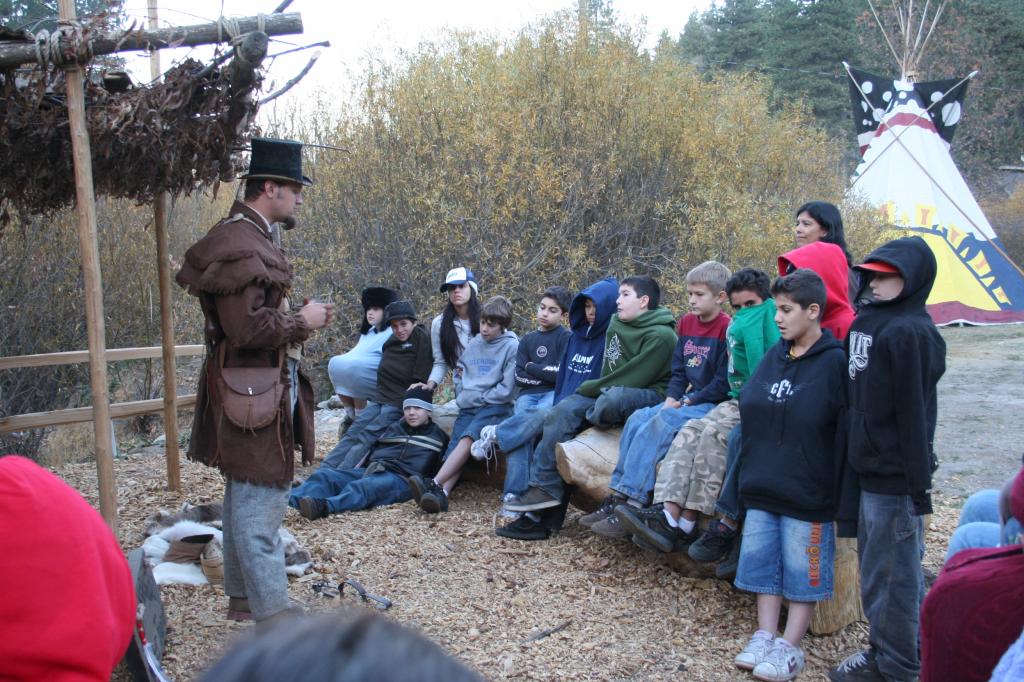
Interpreting to students at Harpers
Ferry National Historical Park


"Shoot it!" came the response from the older boy; the younger one wasn't too sure again.

Oh well, maybe a little too young.


"Well, if you come back in a few years maybe we could put you in a uniform and try firing the rifle sometime like I do here at this reenactment."


"Yeah, wouldn't that be great, son?" Said the father, tousling his son's hair. "Well, it was good talking to you." I guess he is wrapping it up for me. "Where is the best spot to watch the next battle?" I give him my best guess of where that might be and wish him and his family a good day.


This example of the interpretive equation illustrates one of countless variable contacts with the public. It wasn't based on a single actual incident, but composites of encounters that I have had with people visiting. It just takes some motivation, knowledge of the resources you have, best figuring for your audience, and using what it takes to make that connection using the techniques that you have learned. It really doesn't take formal training, but the formal training helped clarify what I did in order to make the best of working with the public.

Tuesday, August 5, 2014

Making Personal Connections

Honest Interpretations
From time to time, I get scheduled to work in the Implements Dealership at Living History Farms. It isn't as awesome as the print shop, or the broom maker shop, at least, initially, but it has a lot of neat things in there. I read through the Site Manual through a month and a half ago, and I don't get many chances to work there so I feel the need to read it when I get a break in visitors to dig a little deeper. This time around I found a excerpt mentioning that the Implements dealer has the ability to interpret the entire farming cycle in one room, whereas the farm sites are stuck interpreting the season, here and now. Also the farms aren't always open during the times when plowing or planting is done, or it may have happened on Monday but visiting on Tuesday. The Dealership has plowing, planting, harrowing, cultivating, reaping/mowing, threshing/separating, milling, and storage tools; a full cycle under one roof. The Implement Dealer interpreter can guide a curious life learner into options for low budget hand tools to glitzy pinstriped horse drawn labor saving machines. The colors of the tools do get occasional mention. The machines are restored to their original colors, or to colors that were typical of the time. I try to make the connection to the modern day by comparing it to cars. A maker makes a certain type of car that all have the same options. But would it sell if it was metal colored, or rusty brown? No! They come in all colors! The primary sources show that the implement dealers then knew farmers would buy an implement if it was green if the farmer liked green, even if a blue or a red one did the exact same thing. Pin-striping and stencil work were also common on them, think of it as being a SE or LE model.

US Dragoon c. 1840's Fort Scott NHP in 2013
But I want to get to the title of the post, "Making Personal Connection". It's very important to make a personal connection with your visitor when they come to your interpretive station and have them make a personal connection to your content. Many of the people coming into the Dealership are farmers or former farmers, or formerly raised on a farm. Many point out the things they had or one of their relatives had or something similar sitting in the shed or someplace. They are interested in it because they have a personal connection. Had I visited a year ago, without any farming background to my name, I might have spent 30 seconds browsing through. If I was feeling adventurous, maybe ask a few questions. I didn't have a personal connection then. Making a personal connection with a visitor to the content can be challenging, particularly if they are young and have no farm experience. I can usually point out a few things there that have a relation to the things they have or do today and I try to be as hands-on as much as possible, especially with a lot of "Don't sit on the machinery" signs around. If nothing else, doing some hands on stuff, making a few modern life applications, and friendly banter is enough to make that connection.
However, the real reason I sat down to write this post is the personal connection I have to the content. When I was doing stationed interpretation at Fort Scott National Historic Site, I didn't have much of a personal connection to the US Dragoons, nor the Guardhouse where I was stationed.
I chose it for the novelty of it. It seemed their male interpreters had chosen to do infantry stationed interpretations and no one had done a Dragoon one for a while and it was another opportunity to learn something new. But there was no personal connection, I didn't have an ancestor ride with them, at least so far as I know.

Reading up on the latest at the Dealership

I didn't have a personal connection with the Implement Dealership either, or so I thought. I had posted a picture of myself in the office at a quiet moment onto a social media site. Mostly for my historically minded friends to appreciate it. However, one of my uncles responded to say that my great- great-grandfather would be proud of me. Honestly, I had no idea what he was talking about and so inquired why the case may be. He sent me a photo of my great-great-grandfather's implement store  and grain elevator in Ramona, South Dakota circa 1913.
The Store is the first on the left of the top photo

I had seen that photo before, but did not have a connection with it. I've been to Ramona once, in third grade, and farming was then foreign to me. So it faded from memory probably written about in a sixth grade family history project, also long forgotten. However, now I have a personal connection to the work that I do at the Implements Dealership. It's now a family thing and a emotional thing as well. Without making the connection too dramatic, it is like being a city kid all your life and getting a job working as a blacksmith at Knott's Berry Farm because the pay was kinda better and finding out your family in a distant state in a distant time were blacksmiths too. It gives an extra spring in your step, I think, or motivation at the very least to going to work if there is a connection to it. Interpretation is about making connections, on some level. There are personal connections with your content at a emotional level, personal connections with your visitors on a human level, and making connections with the visitor with the content to their lives. Make the connections.

Friday, July 25, 2014

"How can - I - change the world? I'm only one person!"

This is a modification of a Facebook post I made on June 28th, 2014 about the start of the Great War...
"I'm just one person, how can I change the world?" You have the power to alter the course of history profoundly. Take for instance Gavrilo Princip (pronounced [ɡǎʋrilɔ prǐntsip) Have you ever heard of him?
Gavrile Princip. Photo coutesy of Wikimedia Commons.
Most people haven't. Standing outside a deli in Sarajevo 100 years ago on June 28th 1914 and two bullets later Gavrilo Princip created the geopolitical world as we understand it today. He shot Archduke Franz Ferdinand of Austria and his wife, the result was an ultimatum from Austria-Hungary to the Serbia that would fail to be met. That set in motion a web of treaties and counter treaty measures that made up the turn of the century politics and was thought to prevent war, but instead forced war to come and would end up with the bulk of the "civilized" world going to a unprecedented level of war so bad it has yet to be duplicated. The reverberations of which continued for years, even to today, some of which include a second world war, the collapse of the Austrian-Hungarian and Ottoman Empires, the slow deterioration of the British colonial empire, the rise of nationalism in colonial powers including the Vietnam conflicts, middle east unrest and rise of Communism in Russia and all those implications as well are only a few consequences. Gavrilo Princip never saw this. He died of tuberculosis in jail months before the first war ended. Today would have been his 120th birthday had he lived that long.

What can one person do? They could make a decision that unleashes a wave a destruction that would wash the old world away and derail the lives of so many people that it is truly incalculable. I'm not advocating assassination or mayhem, only a reminder of what our power of choice can do, good or bad, for decisions great and small. We have that power, the same as Gavrilo.

  Be careful what you do with your powers.