--This topic may be controversial and may include some pictures that some people might object to. If you feel you can handle it, read on.--
Thursday, November 26, 2015

Saturday, October 17, 2015
Oct 17 and 19, 1781, the Surrender of Lord Cornwallis to Washington
A white flag of truce held aloft. A simple symbol that meant so much on that 17th of October. It was 1781 and it had been six hard years of fighting since Lexington and Concord. With the flag of truce, the Continental Army had a decisive victory over Cornwallis' army pinned against the James River in Yorktown using a coalition of French troops and navy with the Continental Army. The 18th was a day of negotiations and deliberations. A thrill of victory elated the spirits of the victorious as they watched their British foes march away with arms reversed on October 19th when the terms of surrender were agreed upon; however, their feeling was temporary. The fighting was not over. Indeed, it would not be over until the peace brought by the treaty made it ashore and into the farthest frontier places of the British Empire and the new American nation. This happened nearly two years later because of difficulties in traveling around the world to inform everyone that the war was finally over. But at that time and place they had a significant victory, and to the British, it was a significant enough of a victory to realize that it was useless to continue. It was only later that Cornwallis' surrender at Yorktown was viewed as the final battle of the Revolutionary War.
Some might recognize July 4th, 1776, as the most significant date in the history of the United States, since that is the date most associated with our national independence. But July 4th would only be a vague date of a piece of trivia had not Lord Cornwallis given the order to surrender. Nor would it be remembered had the war ended badly for Washington. As October 17th and 19th come and go this year, it is easy to not remember their significance. They will probably pass without much media or social comment since 2015 is not a significant anniversary year (The 234th anniversary). Still, without that surrender, the war could have dragged on. The United States, for all it's worth, good or bad, would not have existed if the British held out. Because of that surrender, our national history began, our independence was validated, and the separation from Britain was complete.
Just some thoughts I have on this date.
 |
| The Surrender of Lord Cornwallis is an oil painting by John Trumbull. The painting was completed in 1820, and hangs in the rotunda of the United States Capitol in Washington, D.C. - From Wikipedia |
Some might recognize July 4th, 1776, as the most significant date in the history of the United States, since that is the date most associated with our national independence. But July 4th would only be a vague date of a piece of trivia had not Lord Cornwallis given the order to surrender. Nor would it be remembered had the war ended badly for Washington. As October 17th and 19th come and go this year, it is easy to not remember their significance. They will probably pass without much media or social comment since 2015 is not a significant anniversary year (The 234th anniversary). Still, without that surrender, the war could have dragged on. The United States, for all it's worth, good or bad, would not have existed if the British held out. Because of that surrender, our national history began, our independence was validated, and the separation from Britain was complete.
Just some thoughts I have on this date.
Thursday, September 24, 2015
Interpretive writing piece about my present exploits in national service
This summer I took an online class on Interpretive Writing. As a result of my completion of this course, I decided to write a brief interpretive piece on my present work that I have been at for the last year as a way of both informing my readership of my present activities and of starting to use the knowledge I have gained from this course.
***
 Gardening is a dirty business. As we develop new gadgets and technologies that keep us happy indoors in our sanitized little worlds, there are those of us who are still outside getting dirty, because food just does not appear without some work. Though, most of the time, it's fun. It takes time, planning, planting, and tending to get a seed to sprout, mature, and begin to produce a product that we can eat. Think about some of your favorite foods for a second. Which ones are fruits or vegetables? What foods are meat or dairy? Do not the animals that meat and dairy come from eat vegetables? Food is a very important topic to many of us. We are born hungry and will be hungry in a matter of time, so it is important to have food to eat. The sweat on our brow, muddy boots, dirt under out nails, and full baskets proclaim our good work in making that happen for some people.
Last year when I worked at Living History Farms, the gardens were an important part of the exhibits there. Gardening was important for healthy lives in the past just as eating healthy is today. I learned a lot about growing and resources to use from Living History Farms and I was able to apply them to what I do now at the Northeast Iowa Food Bank. I am an AmeriCorps VISTA (Volunteers In Service To America) and I give a year of my life in national service. I recruit, train, and manage volunteers for the Food Bank's quarter acre garden. I choose the growing strategy for the garden and thus selected to plant fruits and vegetables that the Food Bank does not get a lot of donations for, and pick a wide variety for people to enjoy once the produce is harvested and sent to the onsite pantry. Bright tomatoes, supple beans, hearty peppers, brightly colored Swiss Chard, leafy kale, spicy radishes, petite peas, prolific squash, and heavy watermelons are some of the things we grow.
Why do we grow a garden at the Northeast Iowa Food Bank?
We grow a garden because we care about people. 1 in 5 children are food insecure in Northeast Iowa; that means that you probably know someone's child that does not know when they will next eat a meal (if you are living here in Iowa). Also 10% of senior citizens in the Northeast use the Food Bank. Some have difficulty living on a a fixed income; others are shut-ins and cannot provide for themselves. At a time in our history that we have the most amount of food in America, people cannot get enough to eat in some communities, or have access to healthy foods. Something must be done to help these people.
Hunger affects us all, for we all get hungry. Perhaps you can recall a time when you were hungry. Were you agitated? Weak? Unfocused? Image being like that for a week or more. This is the reality of some people not just here in Northeast Iowa, but all over the United States, and all over the world. We all hunger, which is one of the traits that unites all living things, yet there are things that we can do to help. September is Hunger Action Month. Orange is the color that we wear to raise awareness to bring the cause of fighting food insecurity. I garden to fight this, to provide nutritious food, but I also teach students how to grow their own food, and next year I intend to prompt the next Garden Coordinator to teach classes for our pantry clients. You may have heard a phrase,"Give a man a fish and he will eat for the day, but teach a man to fish and you will feed him for a life-time." I can do that same thing, but with growing food. But that is what I can do; there are ways that you can help too if growing food is not what you do. As I am nearing the end of my term of service with AmeriCorps VISTA, I can see how I have grown as a gardener, and as a person who cares for people. What I can say is this: find out how to help others, and maybe it will grow on you.
***
Break down
Categories for structure and content are in blue, my answers are in red.
Gardening, food, work - tangible
Hunger Action Month - intangible
Hunger/eating and helping others - universal
Food insecurity - conflict
***

Last year when I worked at Living History Farms, the gardens were an important part of the exhibits there. Gardening was important for healthy lives in the past just as eating healthy is today. I learned a lot about growing and resources to use from Living History Farms and I was able to apply them to what I do now at the Northeast Iowa Food Bank. I am an AmeriCorps VISTA (Volunteers In Service To America) and I give a year of my life in national service. I recruit, train, and manage volunteers for the Food Bank's quarter acre garden. I choose the growing strategy for the garden and thus selected to plant fruits and vegetables that the Food Bank does not get a lot of donations for, and pick a wide variety for people to enjoy once the produce is harvested and sent to the onsite pantry. Bright tomatoes, supple beans, hearty peppers, brightly colored Swiss Chard, leafy kale, spicy radishes, petite peas, prolific squash, and heavy watermelons are some of the things we grow.
Why do we grow a garden at the Northeast Iowa Food Bank?
 |
Ryan with some of the produce; Georgia
collard greens in the foreground, Toscano
kale behind me, and Bright Lights
Swiss Chard after and Marigolds beyond.
|
Hunger affects us all, for we all get hungry. Perhaps you can recall a time when you were hungry. Were you agitated? Weak? Unfocused? Image being like that for a week or more. This is the reality of some people not just here in Northeast Iowa, but all over the United States, and all over the world. We all hunger, which is one of the traits that unites all living things, yet there are things that we can do to help. September is Hunger Action Month. Orange is the color that we wear to raise awareness to bring the cause of fighting food insecurity. I garden to fight this, to provide nutritious food, but I also teach students how to grow their own food, and next year I intend to prompt the next Garden Coordinator to teach classes for our pantry clients. You may have heard a phrase,"Give a man a fish and he will eat for the day, but teach a man to fish and you will feed him for a life-time." I can do that same thing, but with growing food. But that is what I can do; there are ways that you can help too if growing food is not what you do. As I am nearing the end of my term of service with AmeriCorps VISTA, I can see how I have grown as a gardener, and as a person who cares for people. What I can say is this: find out how to help others, and maybe it will grow on you.
 |
| Produce from the Garden |
***
Break down
Categories for structure and content are in blue, my answers are in red.
Possible Audience: Diverse adult audience
Great interpretive stories include three things:
- Memorable character development of a tangible resource at the site.
- The intangible meanings and/or universal concepts related to the tangible resource.
- Some degree of conflict or tension.
Gardening, food, work - tangible
Hunger Action Month - intangible
Hunger/eating and helping others - universal
Food insecurity - conflict
To identify the good stories at your site, consider answering the following questions about the resources at your site:
- Is there conflict between people and natural systems? Yes, unequal access or ability to obtain proper amounts of food.
- Is there a resolution or non-resolution of conflict? Non-resolution, the problem continues.
- Are there consequences of action or in-action? Implied consequences of inaction, positive consequences for action.
- Describe broad desired outcomes.
- Connect to the website's purpose and significance.
- Connect to the interests of the visitor.
Goal of the the Interpretive piece: To inform readers as to my recent activities, display interpretive writing techniques and concerns, and raise awareness to a great cause.
Objective statements should:
- Clearly describe what you hope the reader will be able to know, do or feel as a result of the writing.
- Use action verbs.
- Allow you to get a sense of whether you are accomplishing your goals.
- Include specific, measurable outcomes that could be evaluated.
- Objectives for interpretive products should include specific measures of the interpretive outcomes.
- When writing your objectives, be sure to include interpretive outcomes instead of purely knowledge based objectives.
Objectives of this interpretive piece:
The reader will be able to identify where I have been working for the last year.
The reader will be able to state some of the produce grown in the garden.
The reader will be able to state some reasons why gardening is important.
The reader will be provoked into making a decision about food insecurity.
Themes: Themes reveal the topic's relevance to the audience. Themes examine something meaningful about the resource, are relevant to the audience, and provide opportunities for the reader to find their own meanings in the topic of the writing. Your theme will be relevant to your readers if you include a universal concept and answer the questions "So what?" and "What's in it for them?"
"Ryan's experience gardening for the Food Bank has helped him see how gardening helps the hungry, food insecure people of Northeast Iowa, and wants others see this too."
***
By breaking down an interpretive piece, the main basic components of interpretive writing can be seen and examined. I hope that you can see now what I did and how I did it and why it is important to answer some of the tougher questions, like, "So what?" Making a topic relevant and meaningful is not easy, but is essential for making it worthwhile. I cannot write to inform people and expect those people to care if it does not touch them or appeal to them. I hoped you liked this brief interpretive piece and I may spend some time to make a few more here and there.
Monday, August 24, 2015
150th Commemoration - Home Sweet Home at Fort Snelling
We, as a human race, would like to think ourselves and our actions significant. We ascribe meaning and value to our actions and efforts. When one of us does something powerfully extraordinary, we note it, save it, clip out the newspaper headline, or give trophies and honor. We remember and honor our losses as well. Birthdays are a great example of this. We mark the date on our calendars to commemorate the delivery of a baby and to celebrate how that person has grown and what they have accomplished on that date. We gather and celebrate them. Even after their death, we celebrate their life even in our grief and memory. Commemoration, the celebration of beginnings, endings, life, struggle, death, or loss, is a powerful force in our social lives.
What drew me to this event was how unique it was. The event included arrival by paddle-wheel boat, marching to the fort, barrack life and displays, welcome home celebration meals, pay and final discharge from the army, and it was not a far drive for a 150th commemorative event. I registered early and through a fortuitous acquaintance I managed to secure a spot with Co. K, the unit designation for the campaigner group "the Hairy Nation Boys". The Hairy Nation typically does a first-person interpretation, so I had to create a backstory for myself for this event. It was my first time doing a solid first person impression for a weekend and I think I did well. I had an opportunity to meet some of the members of the Hairy Nation before we went to this event at a training march in April and that helped smooth the transition coming into a company without knowing anyone.

While there are a number of ways to mark the end of the Civil War and the close of the 150th anniversary series, I felt this was a fitting end. When I held my salute at Appomattox Court House back in April, it was the end of a chapter in American history as another chapter quickly took its place. Too often we see the troops and the battles and the gore and we lose sight of what matters most of all to us. I think that is the personal stories of people living in their historical context. I think in seeing the war and large movements, we lose the individual soldier and their story.
It is because of these things that we commemorate. Real live breathing, dreaming, flawed people wanted to make their lives meaningful and so they commemorated their lives in to a shared understanding of their experience; in this case, we commemorated the individual soldiers coming home after long years of hardship, trial, and danger and their lives mattered to them, each other, and their families. We remember their lives in history as a whole, in things like regimental histories or in large battle, but the families keep the memories of their individual soldiers. Because if you examine, memory is a root word for commemorate; memory is essential to commemorations. We mark the years that have passed since then; the old veterans met and recollected, their families
heard their stories, and they carried on those traditions and stories in their own ways and passed them to their children, and so on. So when the Civil War Centennial anniversaries started back in the 60s, the stories of family members long gone and the impact of the Civil War, both good and bad, struck a chord in our collective understanding to commemorate the 100 years that had passed since then. That chord strike reverberates to today 150 years later and in all sorts of ways.
I loved this event because it was about regaining the story of the individual soldier; about people moving on in their lives. It was about people who had done some extraordinary things becoming citizens that created the rich fabric of our reintegrated nation. As the 150th anniversaries close, we choose to remember and commemorate the efforts, sacrifices, and lives of the soldiers who fought this war and to do them justice in our portrayal of them so that others can learn from them.
I bring up commemoration because I recently commemorated the end of the Civil War in a very unique way. This post is about the mustering out of the 2nd Minnesota reenacted and commemorated at Fort Snelling. The 2nd Minnesota had an impressive record, not as famous as the 1st Minnesota of Gettysburg, but perhaps more so. They defended Snodgrass Hill with Gen. George Thomas "The Rock of Chickamauga", stormed up and overran Missionary Ridge, fought through Atlanta and to the sea, up through the Carolinas, took the surrender of Johnston's army, and marched through the streets of Washington City in the Grand Review. Now they were coming home to where most of the veterans had mustered in and our job was to portray them.
 |
Unintentional posing by the sign
Shared from Friends of Fort Snelling
|
The weekend of the event, we carpooled to the event site. There we finished our
paperwork, were given our corps badges, and were given the location of which barracks rooms we were to occupy for the weekend. We made bedsacks (mattresses bags) beforehand that we stuffed with hay, rather than sleep on the hard and uneven floor. That was another thing that does not happen at every event: sleeping in buildings and mattresses. At the evening formation we practiced the parade-ground maneuver that we were to perform for the crowds tomorrow. Soon the mosquitoes and the sunlight were out and I went to bed, because the next morning was going to be an early start so we could get breakfast and our gear prepared for the boat trip and our grand entrance.
paperwork, were given our corps badges, and were given the location of which barracks rooms we were to occupy for the weekend. We made bedsacks (mattresses bags) beforehand that we stuffed with hay, rather than sleep on the hard and uneven floor. That was another thing that does not happen at every event: sleeping in buildings and mattresses. At the evening formation we practiced the parade-ground maneuver that we were to perform for the crowds tomorrow. Soon the mosquitoes and the sunlight were out and I went to bed, because the next morning was going to be an early start so we could get breakfast and our gear prepared for the boat trip and our grand entrance.
 |
Boat ride! Preparing to disembark
Shared from Here
|
Here we see the recreated 2nd Minnesota Infantry marching to Fort Snelling. What a grand sight.
Posted by Historic Fort Snelling on Saturday, August 15, 2015
Our arrival at the dockside Saturday morning was exciting to ourselves and curious onlookers. Once aboard, we made our way down river enjoying the breeze, a cookie or two, and the pleasant conversation about what we will do once we are discharged. We arrived at the shoreline after some skillful maneuvering by the ship's pilot, the gangplank was lowered, and we carefully made our way into the interior shaded area. There we assembled, reformed, called roll, inspected arms, and got our one blank round for a firing demonstration. We marched up the steep incline with our martial music, took a break to collect our stragglers, and marched toward the gates of the fort and the cheering crowds. It was a emotional and moving sight to behold.
There we were 'speechified' and dismissed to the barracks and soon to the chow line. From there our act was boredom, anxiously waiting for pay and to go home. The next day was more formations for the crowd. We lined up for pay call and filled out paperwork regarding our final discharge. It was a surreal moment signing my name to sheet. We had to leave early so I was not part of the formal dismissal, which disappointed me, but the cool parts were already behind us.
There we were 'speechified' and dismissed to the barracks and soon to the chow line. From there our act was boredom, anxiously waiting for pay and to go home. The next day was more formations for the crowd. We lined up for pay call and filled out paperwork regarding our final discharge. It was a surreal moment signing my name to sheet. We had to leave early so I was not part of the formal dismissal, which disappointed me, but the cool parts were already behind us.

While there are a number of ways to mark the end of the Civil War and the close of the 150th anniversary series, I felt this was a fitting end. When I held my salute at Appomattox Court House back in April, it was the end of a chapter in American history as another chapter quickly took its place. Too often we see the troops and the battles and the gore and we lose sight of what matters most of all to us. I think that is the personal stories of people living in their historical context. I think in seeing the war and large movements, we lose the individual soldier and their story.
 |
Boat ride! Preparing to disembark
Shared from Here
|
It is because of these things that we commemorate. Real live breathing, dreaming, flawed people wanted to make their lives meaningful and so they commemorated their lives in to a shared understanding of their experience; in this case, we commemorated the individual soldiers coming home after long years of hardship, trial, and danger and their lives mattered to them, each other, and their families. We remember their lives in history as a whole, in things like regimental histories or in large battle, but the families keep the memories of their individual soldiers. Because if you examine, memory is a root word for commemorate; memory is essential to commemorations. We mark the years that have passed since then; the old veterans met and recollected, their families
 |
Glad that the war is over, but seeing papa alive and well
means more to individuals
Shared with Historic Fort Snelling
|
I loved this event because it was about regaining the story of the individual soldier; about people moving on in their lives. It was about people who had done some extraordinary things becoming citizens that created the rich fabric of our reintegrated nation. As the 150th anniversaries close, we choose to remember and commemorate the efforts, sacrifices, and lives of the soldiers who fought this war and to do them justice in our portrayal of them so that others can learn from them.
 |
Parade - rest
Shared from Friends of Fort Snelling
|
Wednesday, July 15, 2015
Interpreting Our Heritage by Freeman Tilden
It was going to happen sooner or later. One probably cannot have a blog on interpretation and not talk about Freeman Tilden's Interpreting Our Heritage at some point. I've already referred to it previously and we also had an introduction to Freeman Tilden by guest blogger, Hilary Grabowska, but I felt it needed a full post to do it justice.
Interpreting Our Heritage is one of first documents on interpretation, regardless of it being environmental or historical. It is the first book of its kind to lay out a basic definition of interpretation and is the first book the National Parks use to train ranger interpreters. I first read Interpreting Our Heritage in grad school where it was part of the Introduction to Public History class taught by Dr. Raymond Rast at Cal State University Fullerton. When I accepted an internship at Harpers Ferry National Historical Park in summer of 2010, this book was one of the books I brought with me, and was part of my reading requirement.
Masterfully written by Freeman Tilden, it lays out what interpretation is, what it isn't, and how it works. Freeman had worked at a number of National Parks and talked to many visitors about why they wanted to go to National Parks, what they expected to see, and what they were enticed into learning. At its basic core, interpretation is an elective education. As such, a visitor could simply walk away whenever they are inclined to, for whatever reason. Because of this, the methods used by interpreters work to try to find subtle means of captivating the audience into enjoying themselves unexpectedly. It is used by the National Parks as the basis for their interpretation programs, but other state, local, municipal, and private locations use the principles as well.
Tilden developed 6 principles of interpretation. He knew he would miss a few and admitted that the 6 are probably not the only ones, but set them forth as a starting point for others to build on. The 6 principles are:
1. Any interpretation that does not somehow relate what is being displayed or described to something within the personality or experience of the visitor will be sterile. This means knowing the audience or finding universal truths that resonate with them. If it is something that doesn't excite them, can you find something that will? Because they will not engage, participate, understand, or care if you can not reach them personally.
2. Information, as such, is not interpretation. Interpretation is revelation based on information. But they are entirely different things. However, all interpretation includes information. Compare a novel and a dictionary. A dictionary has information and facts. A novel has information and facts too, but the information and facts tell a story. Which one is more engaging? The revelation of facts and information is part of the interpretation as well as it is the discovery (and sometimes mutual discovery) that leads to a greater experience.
3. Interpretation is an art, which combines many arts, whether the materials presented are scientific, historical, or architectural. Any art is in some degree teachable. Interpretation is an art because it is an interpersonal skill, like public speaking, haggling, and story-telling. Interpretation covers a wide variety of content. I like the historical stuff. Others get excited about geology. I am not excited about geology. But if I find the right interpreter who can make geology less boring, I will stick around to listen or participate. Because it is a skill, it can be taught. If it can be taught, it can therefore be learned.
4. The chief aim of interpretation is not instruction, but provocation. This is the most important lesson right here. It is hard to get to successfully, but to provoke a listener by your interpretation into some kind of action is the result of a successful interpretive lesson. This provocation can be mentally stimulation, physical action, or spiritual contemplation or any combination.
5. Interpretation should aim to present the whole rather than a part, and must address itself to the whole man rather than any phase. Presenting the whole means using the example to apply to the larger, general, universal themes. Not just the trees, but the forest, and even forests everywhere. The tricky part is addressing the whole person rather than any phase. This also has to do with reaching out to the visitor and grasping a hold of something that interests them, whether something specific or universal.
6. Interpretation addressed to children (say up to the age of twelve) should not be a
dilution of the presentation to adults, but should follow a fundamentally different approach. To be at its best it will require a separate program. This is a fight against the infamous "dumb-ing down" approach. Kids can be very smart; you just have to explain things differently to them, even if you have to have a separate program to develop so that they can understand what is going on.
Perhaps the most impressive chapter he wrote was on the "Priceless Ingredient." There, he addressed a topic that he does not put forth into a principle, but is essential to interpretation, and that is love. Yes, you read that right; love. A love for people and for your work as a interpreter. He goes so far to state that if his principles could be summed up into a single principle, that principle would be love. Because if you love people, then you will try to reach them where they are without being intrusive to their lives and step toward their understanding. A love for the content, craft, learning, or place makes it all worthwhile for a visitor. People are attracted to people who are alive with their vibrancy. If you get into a conversation with any enthusiast, the conversation will turn to their pursuits will be only be a matter of time, if not right away! For a book that tends to be long winded and dated and full of archaic quotations, this single chapter was pure gold to me.
Tilden's writing style is out of vogue with today's styles of writing. I am afraid to say that many people I know find it difficult to read. He reminds me much of the writer C.S. Lewis, in that he has a lot to say, takes a long time saying it, and you are not quite sure what you understood when you heard it, but it only made sense after you have digested it much later. In this sense, the text is dated. So it may be a difficult read for someone who is not used to - or have the patience for - reading older styles of writing, but if you are a history major, this kind of writing should not be too difficult for you.
The NPS holds Tilden in a very high reverence, such that I know no other book on interpretation other than Interpreting Our Heritage, even though it was written well over 60 years ago. I feel that in many ways, the NPS has not moved on from this book or that there is no follow through (that I am aware of) to a more modern and expanded understanding of this craft. I'm sure some of you know of a few contenders that are great books to follow up from Tilden's classic. I think it would be a good idea to post some further suggestions for reading material in the comments and I will see if I can review those at a later date.
 |
| From the NPS website |
Interpreting Our Heritage is one of first documents on interpretation, regardless of it being environmental or historical. It is the first book of its kind to lay out a basic definition of interpretation and is the first book the National Parks use to train ranger interpreters. I first read Interpreting Our Heritage in grad school where it was part of the Introduction to Public History class taught by Dr. Raymond Rast at Cal State University Fullerton. When I accepted an internship at Harpers Ferry National Historical Park in summer of 2010, this book was one of the books I brought with me, and was part of my reading requirement.
Masterfully written by Freeman Tilden, it lays out what interpretation is, what it isn't, and how it works. Freeman had worked at a number of National Parks and talked to many visitors about why they wanted to go to National Parks, what they expected to see, and what they were enticed into learning. At its basic core, interpretation is an elective education. As such, a visitor could simply walk away whenever they are inclined to, for whatever reason. Because of this, the methods used by interpreters work to try to find subtle means of captivating the audience into enjoying themselves unexpectedly. It is used by the National Parks as the basis for their interpretation programs, but other state, local, municipal, and private locations use the principles as well.
 |
| Freeman Tilden, from Npshistory.com |
1. Any interpretation that does not somehow relate what is being displayed or described to something within the personality or experience of the visitor will be sterile. This means knowing the audience or finding universal truths that resonate with them. If it is something that doesn't excite them, can you find something that will? Because they will not engage, participate, understand, or care if you can not reach them personally.
2. Information, as such, is not interpretation. Interpretation is revelation based on information. But they are entirely different things. However, all interpretation includes information. Compare a novel and a dictionary. A dictionary has information and facts. A novel has information and facts too, but the information and facts tell a story. Which one is more engaging? The revelation of facts and information is part of the interpretation as well as it is the discovery (and sometimes mutual discovery) that leads to a greater experience.
3. Interpretation is an art, which combines many arts, whether the materials presented are scientific, historical, or architectural. Any art is in some degree teachable. Interpretation is an art because it is an interpersonal skill, like public speaking, haggling, and story-telling. Interpretation covers a wide variety of content. I like the historical stuff. Others get excited about geology. I am not excited about geology. But if I find the right interpreter who can make geology less boring, I will stick around to listen or participate. Because it is a skill, it can be taught. If it can be taught, it can therefore be learned.
4. The chief aim of interpretation is not instruction, but provocation. This is the most important lesson right here. It is hard to get to successfully, but to provoke a listener by your interpretation into some kind of action is the result of a successful interpretive lesson. This provocation can be mentally stimulation, physical action, or spiritual contemplation or any combination.
5. Interpretation should aim to present the whole rather than a part, and must address itself to the whole man rather than any phase. Presenting the whole means using the example to apply to the larger, general, universal themes. Not just the trees, but the forest, and even forests everywhere. The tricky part is addressing the whole person rather than any phase. This also has to do with reaching out to the visitor and grasping a hold of something that interests them, whether something specific or universal.
6. Interpretation addressed to children (say up to the age of twelve) should not be a
 |
Interpreting to students takes patience, skill, and
personality, but it takes an intense love to be a
good interpreter.
|
Perhaps the most impressive chapter he wrote was on the "Priceless Ingredient." There, he addressed a topic that he does not put forth into a principle, but is essential to interpretation, and that is love. Yes, you read that right; love. A love for people and for your work as a interpreter. He goes so far to state that if his principles could be summed up into a single principle, that principle would be love. Because if you love people, then you will try to reach them where they are without being intrusive to their lives and step toward their understanding. A love for the content, craft, learning, or place makes it all worthwhile for a visitor. People are attracted to people who are alive with their vibrancy. If you get into a conversation with any enthusiast, the conversation will turn to their pursuits will be only be a matter of time, if not right away! For a book that tends to be long winded and dated and full of archaic quotations, this single chapter was pure gold to me.
 |
| Talking to people about history is what I do. |
The NPS holds Tilden in a very high reverence, such that I know no other book on interpretation other than Interpreting Our Heritage, even though it was written well over 60 years ago. I feel that in many ways, the NPS has not moved on from this book or that there is no follow through (that I am aware of) to a more modern and expanded understanding of this craft. I'm sure some of you know of a few contenders that are great books to follow up from Tilden's classic. I think it would be a good idea to post some further suggestions for reading material in the comments and I will see if I can review those at a later date.
Sunday, June 14, 2015
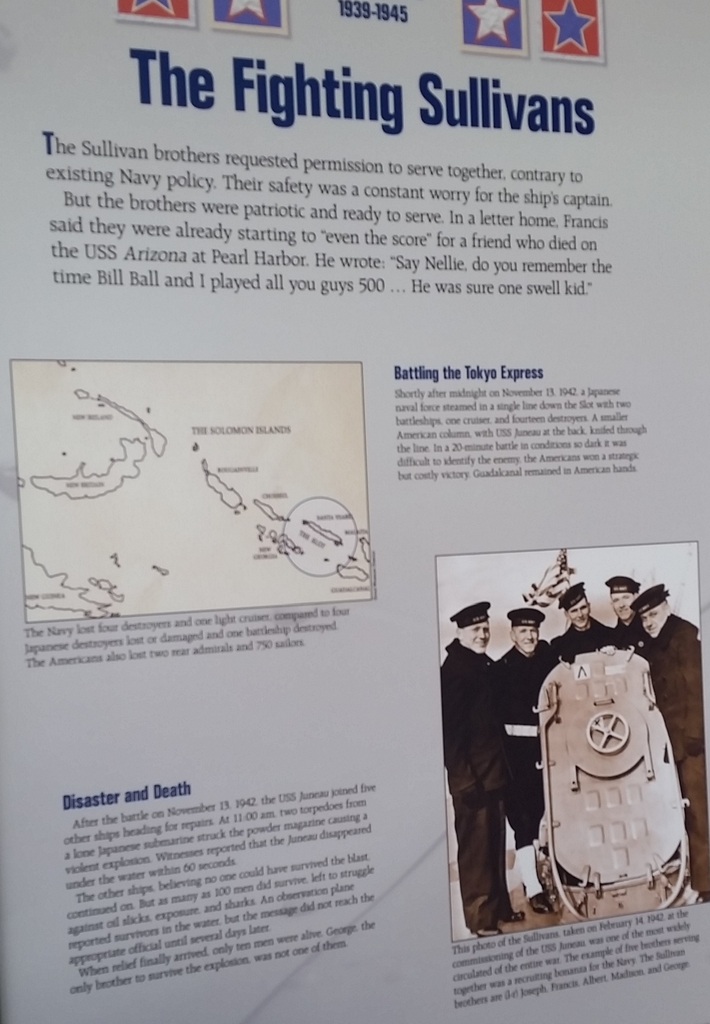
Site Visit: Five Sullivans Iowa Veterans Museum
 |
| Sullivan Brothers Iowa Veterans Museum, Waterloo, IA |
 |
| More information about the Sullivan brothers |
We started down on the ground level because it was the location of the oldest things, pioneer life and the Civil War through to 1920s. Even though I had a map, the flow of the museum confused me. Should I go this way or that way around an exhibit? I ended up going in spiraling clover leaf pathway pattern that saw everything in some sort of order but did a lot of backtracking. There were lots of displays and lots of quick brief placards. High tech interactive touch screen display panels as well as old fashioned glass case displays stood only feet apart from each other, each doing their part of telling the story. There was a mock up of a WWI trench line that had a periscope built in with voice overs and combat sounds. The lower level also incorporated the home front and covered supporting military roles for combat troops, rather than just focusing on the rank-and-file soldiers. Along the back end of the museum was an exhibit on manufacturing and industry in the Cedar Valley area.
Upstairs were the exhibits on WWII to modern conflicts. The upstairs was better designed but flowed
 |
| Interactive Mock-ups |
We also visited two traveling exhibits, the first of which was on Mail Call. This exhibit highlighted how the military and postal services worked to improve morale, communication, and mental well-being of soldiers and how it changed over the years. It was a Smithsonian exhibit and was very well done, but I think due to space constraints had to be located in two parts on separate floors, which made it difficult for continuity's sake.The other traveling exhibit from the National Holocaust Museum was about Germany's concerns for creating a genetically superior race. It described the popularity of eugenics and policies that lead to euthanasia and other similar practiced in the 1930s-40s Germany. It was expansive and thorough and utterly depressing. It was also unfortunately the final stop on the way through the museum so it left my wife and me with bitter last thoughts before leaving. Since these were travelling exhibits that the museum hosted, I will exclude them from my analysis of the museum as a whole, but felt I needed to mention them because it was part of my experience.
 |
| Home front exhibit on the left, Civil War exhibit on the right |
Principle 1: The interpretation should be personal to the audience. Yes, the content was personal to a large extent, particularly by presenting the content in the forms of eyewitness accounts in interactive panels starting with letters. These letters were rewritten on these panels as a legible handwritten type script accompanied by the actual scanned letters. A recording of a voice actor read the letters aloud made it easier to read and would be beneficial to a person who is blind. A visitor could choose to view none, one, several, or all these options at various interpretive interactive panels using a trackball and a 'click' button. I liked those panels because you chose what you wanted to know more about. Upstairs had the addition of recorded experiences of real people recollecting their stories. This made the material less about the conflict, troop movements, and battles, and more about human stories of tragedy, trial, adversity, and humor.
Principle 2: Information is not interpretation. This museum had a lot of information.
 |
Exhibit on the Spanish-American War. A station on learning
how to salute and whom to salute.
|
Principle 3: Interpretation is an art, which combines many arts. Since no person was there to make an interpretive presentation, I decided to take some liberty in answering this category. I viewed the exhibits themselves as the interpreters and I decided to view the displays and presentation from an artistic point of view rather than having material explained meaningfully for this principle. The displays were easy to use, well designed, and of high quality, but gave a lot of information that simply did not interpret things for me.
Principle 4: Interpretation is not instruction but provocation. This is a hard one to determine. Was it engaging? Yes. Did it provoke me? A little. To be honest, the traveling exhibit on Eugenics provoked me more than the regular museum. I did not want to rush out and hug a veteran, join the military, join an anti-war movement, or try to do something better. It was all good information, but it did not spur me into action.
 |
This interactive panel showed the individual troop movements
of every Iowa regiment throughout the course of the war. A
selected regiment's movements were also documented in
relation to the larger war. So, for example, even though a
regiment was in Louisiana during the time of a major battle
elsewhere, that battle showed up on the map along with
the battle engagements that regiment took part in. Parts to a
whole.
|
Principle 6. Interpretation addressed to children should not be a dilution of presentation to adults. The focus of the activities was children's participation, but a child or an adult could have used the interpretive panels. The information wasn't 'dumbed down' or made sterile by word usage, but utilized a 4th to 6th grade reading level that did not have a lot of technical jargon, acronyms, or any gory images. I think kids would enjoy themselves here.
From a visitor perspective: a suggested direction of flow would have been helpful to understanding in what general order I should go to see everything. It should not be so rigid as to force the direction of people by only providing one way out, like some museums do. Discovering that there could have been an audio tour was a little disappointing, because I may have missed something important about each area. The extra areas of the museum that did not pertain to conflicts or veterans seemed out of place in a veterans museum. The history of the Rath meat packing plant? I'm all for it, but not something I was expecting to see in a veterans museum. A display case on the bone structures of a bird? Why is this here? Did I wander into a different museum? Besides these out of context, yet otherwise fine museum pieces, we both enjoyed our time.
Was it worth the price of admission? Absolutely. We could have arrived earlier and stayed later and really digested every panel and every display case, but there was so much to see we felt we had to try to see it all. So if you get a chance to come to Waterloo and see it, I think it will be worth your while.
Sunday, May 31, 2015
Why are there no battle reenactments at NPS sites?
 |
| President Woodrow Wilson from Wikipedia |
The balance, and many times it can be a struggle, is to weigh conserving the natural and historic objects with everything that entails and to provide for the enjoyment of those who visit them unimpaired. This struggle is what I will be looking at this month.
In the 1960s, the centennial of the Civil War began with a reenactment at the battle of Bull Run/Manassas on the battle field. Reenactments are not a new thing in American history; different groups had put on reenactments at various times before for different reasons and had wide varieties of historical accuracy associated with them. In general, they have become more sophisticated and more accurate and, unfortunately, more commercial. Historical accuracy in clothing standards was non-essential; it was the display that counted. Stories have come down through the ages about modifying sport coats and jeans and of firing shotguns and bb-guns. If clothing looked grey or blue, it passed (things have changed much since then, but I see some people's gear and wonder sometimes). Also, the events' attendees left a lot of trash and road ruts. Some questioned whether it was acceptable to play-fight where real men bled and died. For the reenactors' many misguided and thoughtless actions, the National Park Service banned all further reenactments from the National Parks and this rule is in effect today, regardless of what era of conflict that battle took place. The 100th anniversary of the Battle of Bull Run/Manassas was the last battle reenactment of the National Parks. Reenactments, however, continued on private property and some State Parks and, as mentioned, have become progressively better in terms of authenticity standards, litter removal, and environmental impact.
Fifty years have passed since that rule was made and the 150th anniversary season has arrived. As a response to the many questions they get on a wide variety of topics, one of the questions was "Why are there no battle reenactments on National Park grounds?" To answer this question, the National Park System made a video that addressed that very question, and it is featured below...
"Essentially, you are calling reenactors dangerous, destructive, and disrespectful. I find YOU disrespectful."
"Ethics, my hind leg, just wimps in government get-ups."
"This is unbelievably insulting to reenactors of any era."
"Documented? Children picking up loose black powder? Reenactors shooting live rounds at each other? The NPS says they like living history interpretors [sic] helping but according to this video....I guess not."
On the other side, there were other comments that saw this issue differently....
"As a reenactor with a well known group. I totally respect and understand the policy!"
Reenactment has always been one horrible accident away from being shut down. The NPS is not run for reenactors. That said, the vast majority of reenactors and reenactments are very safe and not destructive or unsympathetic to those they portray."
"I believe the NPS is correct in banning battle re-enactments....pointing weapons at other people or even in their general direction is bad policy and a fundamental safety violation. Its stupid people."
"There is no need for reenactments in the park system There are living history demonstrations who show how the weapons were fired and tell all about the battle and what the soldiers went through....Battlefields are not playgrounds for reenactors to pretend that they are living in the past."
And this can (and does) go on. I must admit there is an implied depreciating tone that this video has which does not put reenactors in a good light. I think I would like to make a distinction between terms Living Historian and Reenactor. I have mentioned in the past that I identify with the former rather than the latter because "I take this a bit more seriously". I wish to take a second to define this in a broad, general terms that are flawed and not perfect as a Living Historian is any individual of any time period or era who interprets themselves or their surroundings in costume or uniform. I am defining a Reenactor is a person who dresses in costume for a purpose, usually doing battle demonstrations with little interpretation. It isn't exact but it is a working definition.
Despite all this, I think this is good policy for a governmental entity to have, even though it means I will never do a battle reenactment on the actual soil of a real major battle. Here are some of my thoughts and opinions based on the video's 3 categories.
1) Ethics. You can't argue against the ethics of this. Real people lived, struggled, and died here on this spot that has been specifically chosen to be set apart as being that we as a society and culture want to protect and preserve. As a Living Historian, I have seen some dumb things done while 'dead' at a reenactment: games of Marco Polo, leaning up on an elbow to watch the battle like watching a TV at home, making chit chat, and having a joking conversation during 'Taps' which was played on a bugle at the end of a battle before 'Recall'. All of these are examples fly in the face of people who say that they reenact to preserve the memory, honor the dead, and 'do it just like they did it'. Living Historians and reenactors are a fun-loving bunch but we sometimes forget ourselves. It's like playing a kazoo in a requiem or playing paintball in a cemetery. If we mean to honor our fallen, then let's do it, and a battle reenactment may not be the best way to do so. If we feel strongly about reenacting on real battleground, some of the private battles and state parks have real battlefields that can have a battle reenacted on it because the governing bodies of those places are different. Also, the carnival-like feel of some reenactments that support the event seems a rude way to make money from carnage and the deaths of people who were fighting and dying for a cause in which they believed.
 |
Climbing in Harpers Ferry "Mennen's Borated Talcum Toilet
Powder" from http://www.pbase.com/image/49162350
|
 |
Even though an anniversary battle have a glimpse of the scope
of the battle, it is rarely personal.
From http://maineatwar.bangordailynews.com/2013/09/19/
billy-yanks-and-johnny-rebs-camped-a-valley-apart-at-gettysburgs-150th/
|
3) Resource Protection. This is where the balance of use and protection I mentioned earlier comes into play. The parks are there to use for enjoyment of the visitor, but to the expense of the resource. I would venture that the average reenactor or Living Historian does not consider the environmental impact of their collective presence on a natural resource, intentional or unintentional. Heavy machinery, fire pits, crowds of reenactors and visitors, and their resulting trash and waste are probably the biggest impact to the resources. If you look at the grand spectacle of putting on an anniversary sized reenactment of the last 5 years there was a lot of environmental impact. Tractors hauling machinery, grandstands, booths, equipment, etc, compacting the soil or worse with rutting when the soil gets wet (and it always rains at a major reenactment). Fire is another concern for fear of a larger out-of-control fire that will damage the landscape and wildlife. While reenactors aren't prone to carelessness around fires, the risk remains with more that usual fire pits, fire from candles, and tobacco use. Protecting the landscape is important to the National Parks as well as protecting monuments, waysides, artifacts, as well as the natural environment. One point brought to my attention by a colleague is that larger parks lease land to farmers and a reenactment could interfere with that agreement between a local farmer and a NPS unit.
Another thing brought up was the scope and accuracy of the reenactments. I think if you got all the reenactors and Living Historians world-wide to come to Gettysburg for a big reenactment, we may get close to the numbers of soldiers present on the battlefield when it actually happened. Even if they followed the battle scenario, that plan may be modified to emphasize certain parts of one battle, like "Pickett's Charge" rather than smaller aspects such as "Spangler's Spring". Large anniversary battles also mean that the action often takes place at a considerable distance to the crowds in the paying grandstands, which makes a great spectacle but is far less personal or meaningful. These battles rarely do loudspeaker explanations of what is going on or why the battle is happening like it is. Further, battles themselves are not accurate with the sheer lack of any casualties in the first 5 minutes and a lemming-like wave of deaths toward the last 10 minutes of battle.
 |
The crowd can get closer in interpretive
programs and ask questions, which is what I
like about interpretive programs.
|
So rather than trying to get accuracy and scope correct, the National Parks focus on smaller, specific programs that can be meaningfully interpreted. I have participated in a number of National Park interpretive programs and I really enjoyed them. Even the makers of this video are excited that Living History programs and demonstrations are conducted on their property and are enthusiastic about doing them! It is not like they don't want Living Historians, reenactors or interpreters to do demonstrations; they fully know the power and impact of a good costumed interpretive program can have on a visitor. They are interested in making a personal connection to their resources, rather than just an entertaining show. From what I have observed, there is very little to no crowd interpretation at large anniversary battle other than what is on their programs. The smaller ones are much better at interpretive themselves, but only if the volunteer Living Historians feel motivated to; see my blog post on what that is like. Each National Park wants to do interpret its own unit and make it accessible to the visitors and they use a variety of interpretive methods and programs to draw visitors; reenactment battle just is not a method they use.
The last point I wish to make is the financial cost of putting on a reenactment. There is a lot of time, planning, effort, and money that goes into a reenactment and even more so for a large anniversary battle. I realize that we will not likely have a humongous Civil War anniversary since the 150s are over but this case can be made for other conflicts anniversary battles as well. It is a consideration of whether having a large or small reenactment event is worthwhile. Even if it were allowed, the efforts put into making a reputable reenactment are difficult and expensive and come with all the problems I've already mentioned and probably a few I have overlooked. Reenactors want amenities: access to food vendors, firewood, straw for bedding, and powder reimbursement for cannon crews, but the event needs portable toilets, seating, shade, an emergency response team, parking, and event logistics and flow for not only reenactors but visitors as well. The National Parks cannot sustain these expenses, not even for anniversaries, because the government budget continues to underfund the National Park Service. Parks that are approved to open are being postponed, maintenance is backlogged for want of funds, and parks have to do increasingly more with decreasingly less each year die to budget cuts. There has been a 12% decrease in total budget for the NPS in the last 5 years, a reduction of $364 million, according to the National Park Conservation Association, an advocacy group for the NPS. In view of the decreasing operating budget of the National Park and the expense of putting on a reenactment of a decent size with all the problems mentioned and all the potential things that could go wrong, the National Parks simply have no choice but to stick to this policy for the time being.
 |
| NPS logo from their website |
Those are some of the reasons I think this policy is good. Not great, but good. I am sure I am missing a few points. I am also sure I will be getting comments like "How dare you call yourself a reenactor and support the Parks on this policy" and "You are just sucking up to them" and "You are a sell-out traitor". On the other side, I think the National Parks should revisit and reconsider this policy again. The policy was enacted in the 1960s as a reaction to poor planning on everyone's part and much has changed in awareness on environmental impact and safety since then. I think if it is well done, a battle reenactment could be another interpretive tool in the NPS "tool-box" that helps people connect to the resource that they are trying to protect, so long as there is an interpretive aspect to it, rather than just a show.
When I had originally thought of this topic, I intended a more balanced view of for-and-against but after looking into the topic and doing research I changed my mind about the policy. A reenactment on Park grounds needs to be worthwhile from the Park's perspective as a money making event or an education experience. If it is a money making event, then what are the moral and ethical questions about making money from a military conflict? Will it be profitable or would the expense be paid off after all accounts are settled? If it is an education experience, how can it be an experience that justifies the expense, the maintenance, environmental, and safety concerns? From a Living Historian perspective, why do we need to reenact on the exact grounds in the first place? The power of place is important but is it required? Keep in mind that "it would be cool" is not going to convince officials. If it is to 'honor the fallen', the question will be asked,"Are there other ways to honor the fallen that don't involve changing government policy?" The Park system does not exist as an exclusive playground for weekend warrior reenactors. It is their turf and their rules. In the long run, I think there is room for open discussion about having a reenactment in the Parks, but I do not think that the policy banning such events will change very soon.
Subscribe to:
Posts (Atom)