Friday, July 26, 2019

Book Review: Creating Great Visitor Experiences by Stephanie Weaver, part 1

The need to improve should be an ongoing consideration for a interpretive site, regardless of what kind of site it may be. In the modern contemporary world in which we find ourselves, interpretive sites, whether for profit, nonprofit, or state sponsored, find themselves in competition. This competition is for the the attention of the visitor. The potential visitor is time-poor; with all the labor saving inventions the modern world has given us, we are always spending our precious time on something, whether it is useful or not. For example, a potential visitor could take a nap, watch TV, mindlessly search the internet, read a book, go to a sports game, take a cruise, exercise, or visit a site. What makes them want to come to your site compared to taking a nap? What makes them select your site or a competitor's? Stephanie Weaver's book, Creating Great Visitor Experiences, addresses how interpretive sites, museums, parks, zoos, gardens, and libraries can improve their sites on a practical and affordable level to compete with other options and bring in more visitors.

Book review for Creating
Great Visitor Experiences by
Stephanie Weaver
There is so much in this little book that it really should be considered a workbook rather than an expose or a study. The book is divided in four parts, but for purposes of better understanding, the review of the book will be completed over the course of three blog posts, with Parts 1 and 4 being examined this month and Parts 2 and 3 in the next two months.

One of the points the author makes early on is that the culture has changed. While some have decried the "edu-tainment" industry, it seems that to a degree, it is here to stay. People want to experience a place, not merely be entertained by it or educated by it. Sites (used broadly in the book to include where ever you may be) are in the business of creating and selling cultural experiences. Think of a Disney-themed site and compare it to the last museum, Park, or library you visited; which is more appealing? This kind of thinking should apply to for-profit, nonprofit, and state sponsored sites.

Improving visitor experiences creates repeat visitation, increases duration of visitation, increases education value, creates word of mouth advertising, and increases revenue. All of these things in turn help fund more services, programs, materials, and opportunities.

Likewise, a poor visitor experience is also likely to lead to a poor financial situation. Many missions of the places where visitors go have a preservation, protection, or conservation mission and improving visitor experiences leads to more care and concern about those places.

Weaver argues that the visitor experience has a larger scope than interpretation. Interpretation effort is wasted if the visitor has a frustrating time, like trying to find a bathroom, or not finding a parking space or the front door.

Part of the goal of the book is working with what you have. Sites are not rolling in dough, so improving the visitor experience can be a cheaper and more effective way to bring in more visitors than remodeling. If the customer service is lacking, a new wing and a fresh coat of paint is not going to bring visitors back.

Everything that the site has to offer needs to be evaluated for branding aimed at supporting your message, whether it is called a theme, goal, or mission.

Likewise, a bad visitor experience crushes the financial bottom line. Bad publicity is more likely to be by reported word of mouth than a good experience. One star reviews last longer and tend to hold more weight than five star reviews on travel sites and forums, thus the need to evaluate the entirety of the site, from advertising, parking lots, bathrooms, programs, personnel, and branding. Spare nothing and evaluate everything.

Studying up and taking notes 
Weaver suggests that there is an inside and outside visitor experience. No two visitors are the same. The inside experience is all the things that each visitor brings on the day of their visit, the bad and good days. A visitor may perceive things differently than originally intended by a site. The site cannot really fix what is inside a visitor, but can change the outside experiences of the visitor. That outside visitor experience begins when the visitor decides to visit the site and lasts until they drive away.

The visitor experience does not start at the door. In evaluating the site, step back and look at the whole picture. Everything matters. Your brand, your name,  and your mission is what your site is. The brand is the experience and your brand is only as good as your visitor's worst part of the experience. The exact definintion of brand is discussed in later chapters. All aspects of the experience fit together like a puzzle to form a whole. One bad or missing piece can ruin a puzzle.

Skipping parts two and three for now, part four is the practical side of the book. It gives suggestions for action groups and exercises to be completed to review what each site has, what it does well, and what it could do to improve. The exercises are grouped by each chapter, so an action group could read a chapter and discuss it, or do their "homework" between meets. However, the author suggests reading the whole book beforehand and then go through the book slowly, chapter by chapter, in the action groups. If you are serious about creating a greater visitor experience, this is where all the action is, so do not gloss over the exercises and questions; your site will be better for it.

I found the book useful and thoughtful and worth turning into a blog post. Next month, Part 2 of Creating Great Visitor Experiences will be the focus. One part will be about learning more about the visitor and what they want and what they need. The second part addresses preparing the staff for customer service and investing in them to improve themselves and ultimately, the site.

Sunday, June 16, 2019

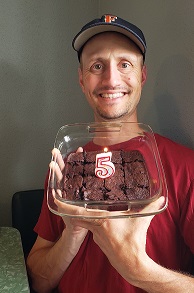
6-16-2019 5 YEAR ANNIVERSARY

Five years can be a long time. It comes down to relativity, in one sense. Five years can be a long time in jail, or it could be a short time watching a child grow up. I'd like to think it to be the latter rather than the former in the case of my blog.

Five years ago, I had toyed with the idea of starting a blog to highlight my career as a historical interpreter and show off all the neat things I get to do or participate in. In some way, that is what this blog has done, so my original intent is still here.

2014 Ryan worked as a seasonal interpreter on a farm.
Over time, it became more of a place where I can show my depth of interest, concern, and understanding of the art and skill of interpretation and the issues surrounding it. Like all things in five years, it has changed. It has changed in becoming deeper, more impacting content than a fun and flashy "look at me" self serving showcase.

Because of this change, it has also been difficult to continue to provide meaningful content. The need to make content interesting, relevant, and important became a struggle to be able to do it. It is one of the reasons why the blog became less spontaneous and a more metered monthly publication.

2019 Ryan is still seasonal but with the National Park Service
Finding content and committing to a monthly deadline has been an education and a discipline that I have had to cultivate as the low hanging fruit of my imagination began to run out of readily available ideas and I have had to look for things that inspire from my career and daily life.

Over the five years, here are five things that I have learned in blogging:

1. Pictures are worth a thousand words. If you look back on my very first blog post, there is not one image. Actually, neither did the second post. Honestly, those were a little boring. They were my first ones, so that can be easily overlooked. More often than not, I have added too many photos and not enough text. I generally plan for between 5- 7 images but only end up using 4-6 depending.

Editor-in-Chief on location in Atlanta
2. You have to make your own noise. Not many people are going to be in your cheer squad, so recruiting people to share and spread is essential.However, I must admit this is an area in which I can improve. I presently only self advertise on Facebook and LinkedIn, but I have to learn more about Twitter. Networking with other bloggers and people who do things that you do helps create community and shared experience. It also seems less like "crying in the wilderness" where no one can hear me make noise. One way for me to improve is to explore better advertising and sharing platforms.

3.Editing matters! Writing is hard work, especially under a deadline. I try to use the Hemingway App to help improve my writing style. About my biggest complaint is that it does not like passive voice. Since much of the content I write about takes place in the past and sometimes by course of natural action and not active participation, the passive voice is simply part of the writing style. I also have an head Editor-in-Chief! She has helped me untangle some frazzled threads that made it onto an editable region on the blog software and turn it into something that makes sense to someone reading it. She has her own blog that she adds to when inspiration and time allow. 

David Connon, the author of the "Maserati"
guest blog post and author of his own blog
Confederates From Iowa
4.Snazzy titles. Perhaps I have yet to learn this one. My most visited and popular post was not written by me, but by a guest. The Me in a Maserati blog post just celebrated its release just 3 years ago. This post has been very popular in Europe, especially in Russia. I think it is because "Maserati" shows up in the title and the search engines worldwide pick it up. Or, maybe it is because David Connon's winsome blog post and his network far outshines my readership ."I think...that it has been your most viewed post because of the wording of the title, and probably particularly because of the word 'Maserati'. " I corresponded with David about the popularity of his post, initially to look at what made the post the most successful one yet but he also had this bit of advice about titles,"I think that writing good, snappy, and/or interesting titles is important if we want to attract readers. But it is hard to do, and sometimes it's like pulling teeth."
5. L shape writing. This kind of writing is similar to using the Hemingway App, in that the short curt sentences are broken up into smaller paragraphs that are easier to read. I still need to revise my earlier posts that use full paragraphs and break them into smaller chunks.

With all things, it is hard to say how much longer this blog will continue to bring the reader fresh content, but it is my intention to keep it up as long as I am able.

If you are a regular reader, then thank you for reading. Please continue to read and learn and give feedback. I appreciate all the help, support, and inspiration over the years!

Sunday, May 26, 2019

Public Speaking Tips

One of the enduring expectations of a history interpreter is the ability to talk with the public. While not all job responsibilities involve dealing with the public on a constant basis, such as a museum technician or a curator, even these kinds of "back of the office" kinds of jobs will eventually involve speaking to the public in instances such as proposals, meetings, or formal speaking events or lectures. Its is simply to be taken for granted, although sometimes, early in one's career in an internship or something similar, someone may not yet understand that talking to the public is expected. This may come as a shock to the kinds of positions that do a lot of research or "back of the office" kinds of jobs. From personal experience, I once knew an SCA intern who was shocked and alarmed that part of her job was to speak to people! She thought that she would be doing visitor center and cash register stuff, not talking to the public for tours or programs. If the reader is in such a situation, what cane be done about it?

Fortunately, the Internet is full of suggestions and information on any topic; a search on public speaking suggestions and tips might be a good idea. Since this blog post is on public speaking tips, it can be supposed that if you are reading this, you have already thought of that.

What this blog post will aim to do is direct recommendations toward an interpretation setting, rather than formal speaking.

The biggest suggestion may seem the most obvious: practice.

All the suggestions that you may have come across previously are probably right; practice in front of a mirror, practice with close friends or family, practice to you dog. Reading it at first helps review it in your mind, especially if the speaking bit was written by you. This helps catch errors and weird sentence phrasing that sounded good in your head and all right in print, but are in truth weird and awkward when spoken aloud.

Speaking from a prepared script helps cement information. In preparing a text, try to use spacing and indentation to "chunk" information into memorable bits with the important parts up front so that if you do forget, your information will be there and everything else is an explanation of your point.

Speaking to children was helpful for me in learning to address larger groups of adults later on. If you are already involved in youth groups, camps, or organizations, this is a chance to practice addressing large groups of people.

I am not sure where this nugget came from, but it is worth repeating: Do not get the attention to a crowd and begin with the words "All right..." and "Okay...". It is an amateurish opening that betrays inexperience. Aim for something welcoming such as, "Good morning everyone! May I have your attention please. As we begin..."

Front-load your structure and introduction. Introduce yourself, your topic, and other concerns, such as a quick safety briefing. In terms of structuring the presentation, address when questions should be asked, midstream or at the end. If it is an educational group, remind them to raise their hands if they have a question. Go back to your learning foundation: tell them what you are going to tell them, tell them what you want to tell them, and then tell them again what you told them. Intro, body, conclusion.

Sweep and smile. Look at everyone in the group at least once, but do not do it for long because it looks like you are staring and it makes people uncomfortable. Smile, too. It makes people think you are friendly. While you are at it, let you hands do the talking. If you do not know what to do with your hands, practice leaving them hang by your sides. It feels weird, but it looks natural.

It is acceptable to have "um" and "uh" in there from time to time. Public speaking, while prepared, has an element of improvisation and sometimes distractions do arise. Being prepared and practiced reduces this.

Be aware of your body language. Keep information relevant and interesting. Many people do not care about the details in a presentation; save those nitty-gritty details for the questions. Review verbal techniques for some ideas on keeping things interesting.

Hopefully, these suggestions help guide the uncertain and inexperienced interpreter into something that they can use to help ease them into becoming more confident in their ability to communicate to the public and increase their ability to reach their visitors.

Next month: The 5 year anniversary of Ryan's Interpretations blog!


Friday, May 10, 2019

People in the History Field: Park Ranger/Acting Chief of Interpretation

What is your name, position, and organization you work for?
Jake Koch, Park Ranger (Acting Chief of Interpretation) Bent's Old Fort National Historic Site, National Park Service (NPS).

What does your job entail? What do you do on a daily basis?
Currently, I wear a lot of hats. My regular position entails overseeing day to day operations at the fort. We are unique because we are a Living History Site. I have worn the regular NPS uniform a total of three times in the last seven months that I have been here; instead I am usually dressed as a fort clerk or drover. I am also the Volunteer Coordinator, the Trails and Rails Coordinator, the Historic Weapons Supervisor, and serve on the Livestock and Historic Integrity Committees. I also prepare division's budget and give performance appraisals to staff. 

What other responsibilities do you have? Things that happen weekly, monthly, yearly, or specially?
Weekly I assist with tours and school programs, certify time-sheets, communicate with volunteers with both Trails and Rails and our Living History program, work on Special Event planning, and inspect our Powder Magazine. I compile the monthly visitor use report, and the annual Volunteer and Historic Weapons reports. 

Do you think you need a degree to get this job?
It is not a requirement, as I know some people in this position without one; however it definitely helps your odds to have at least one degree. I have a Bachelor's in History with a Public History minor, as well as a Masters degree in 19th Century US History. There are also a growing number of schools that offer a degree in Public History that have excellent reputations.

How did you get started in this line of work?
I started as an intern at Harpers Ferry National Historical Park the summer after my junior year of undergrad. That really gave me some valuable experience in the field. Having that on my resume was what earned me a job with a site run by the Tennessee Historical Commission while in grad school, and then my first seasonal position at Vicksburg National Military Park.

How did others get their start? Are there other ways in?
One of the more interesting conversations I have with other NPS folks is hearing their particular path to getting permanent. I was probably one of the last people converted to permanent under the old SCEP program. There are now more ways for those with a certain amount of seasonal time, prior military service, or for students. To be honest, a lot of it seems to be that someone is in the right place at the right time, however, I do feel you create your own luck as well by building your resume and working hard. 

How do you progress in this line of work?
Be prepared to tackle things above your paygrade if given the opportunity. Become involved with professional organizations such as NAI [National Association of Interpreters] or ALHFAM [the Association of Living History, Farm and Agricultural Museums] I am very involved in NAI. There are several different certifications you can work towards to build your resume. There are also leadership positions that you can volunteer for or be elected to that have transferable skills to your everyday jobs, they also help show your dedication to the field. I am an officer for the Cultural and Historical Section of NAI and have served as Secretary/Treasurer, Assistant Director, and currently serving as Director. 

Why do you like this position? What are the benefits? Are these typical?
I literally have my dream job. Living History is my passion, and when done right, it can open up a new world to visitors. I love coming to work every day and am in a place I plan to spend the rest of my career at.

What do you not like about this position? What are some of the drawbacks? Are these typical?
The only downside is the amount of time I have to spend behind a computer screen.. However, that is the nature of the world we live in. It makes me appreciate every moment I can get outside to work with our staff, volunteers, visitors, and livestock. 

Do you agree with the phrase: "Knowing what I know now, I would do something differently"? What would you do?
I don't think so. Hindsight is 20/20, however everything I did led to where I am now. There were jobs I applied for before and finished second for that were devastating at the time; however, sometimes the greatest gifts are things that don't happen. 

What would be the best thing you could suggest to someone if they wanted to be a Park Ranger?
Get involved in as many things as you can at work. Diversify your skill set. Get involved with a professional organization. All that said, make sure and give yourself time away. This career field is full of very passionate people who care about what they do and places they work. That is a good thing, just don't take it to extremes; give yourself time with friends and family. Otherwise, the stress will eat away at you. 

Is this a position that you would recommend to others as a line or work to get into?
Absolutely!

A lot of people are concerned about what the pay would be for their jobs, what kind of answer would you give to answer that question?
I am a GS-9 currently detailed as a GS-11.

Thanks Jake for your insight, visit Bent's Old Fort NHS in Colorado if you get the chance!

Tuesday, April 30, 2019

Stretching Beyond the Comfort Zone

Playing our strengths. Doing what you love. Following your bliss.

Call it what you want.

I'd rather be doing this.
At some point every interpreter develops an interest wherever they find employment. It's natural. However, sometimes you have to step out of that into something less familiar.

Getting outside the Comfort Zone. Diversifying your resume.

Sometimes it happens by necessity, sometimes by design, sometimes by fluke.

While gaining expertise is great, it can also become boring. Getting outside of the norm and learning new things is a part of mental health as it is activating different parts of your brain as you are thinking in different ways, which adds depth of understanding to a resource. The reality is, while it is great to be specialized, it is also preferred by many employers to have employees that have knowledge in other areas. This includes branching out into other disciplines, topics, or content beyond one's preferences. For example, focusing on biology, geology, archaeology, sociology, or any similar discipline rather than history.

Yes, something other than history.

Take a moment to get up off the floor and recover. Deep breaths.

This is only time I have been on a horse.
I was very much outside of my comfort zone
Maybe not so sudden of a shift away. Maybe instead of focusing on what has been done in the past, try developing new material. Check with the supervisor first; don't step on any toes.

Perhaps looking at different aspects that are under-developed at the site. One further example would be to venture into social media, if you have avoided it. Ask to help out with the museum collection. Work with the education specialist to develop new curricula. Learn about the archaeology of the site, if applicable. Do something different where you are.

If you are in the place in your career where your employment is temporary, such as seasonal help, try selecting a site or location or place that is outside of your typical content area.

Geology and I have had a hard relationship,
but it's a discipline worth exploring.
Maybe one day.
For example, if you are interested in prehistoric times, try a site that is more modern. If you specialize in the southwest, perhaps try going to a different region.

Being a temporary employee allows you the opportunity to gain experience by moving around and trying different things. While it may not get you a job as a biologist, it would be an asset at parks, sites, or locations where wildlife is a regular part of the site experience and can even add extra dimensions to the regular programming. 

Stretching your knowledge, skills, and abilities can be uncomfortable at first, especially if it is a topic that is of no real interest to you - yet. Ultimately it makes you, as an employee, more marketable. From my own personal experience, my position as an assistant gardener at a Japanese garden led to other positions with gardening and plant growing parts of a job, which led to full time jobs as a gardener or farmer, and it continues to inform my knowledge and demonstration displays even to this day. Getting outside the comfort zone provides new learning opportunities that can lead to more opportunities down the line. Granted, you will play your strengths, but do not limit yourself. Give it a try.

Sunday, March 31, 2019

Site Visit: The St. Augustine Pirate and Treasure Museum

The St. Augustine Pirate and Treasure Museum
The topic of pirates tend to be a side branch in history. Historians and history buffs tend to prioritize political, military, religious, or social aspects of life, and crime tends to take a weird fifth place. Pirates have been around for hundreds of years, not so long after maritime trade and before navies to police them. However, when most people in the western world think of pirates, they tend to think of what is referred to as the "golden age of piracy" lasting from the 1500s to early 19th century, centering on the Caribbean. Pirates lodge in the popular consciousness as being romantic figures rather than feared and cruel strong arm maritime robbers and murderers.


"Fire" a cannon; a hit with
rambunctious kids
Naturally, this divergent phenomenon is bound to emerge in any serious consideration of pirates, so when an opportunity to visit the St. Augustine Pirate and Treasure Museum in St. Augustine, FL, emerged, this was one of the things that prompted a site visit. The divergence of romantic figures or objects of fear are a matter of interpretation.

The museum is along the main thoroughfare along the seaboard of the town of St. Augustine within sight of the Castillo de San Marcos, the fort built to protect the city from attack, pirate or legitimate military.

The museum had moved from Key West in 2010 when the museum owner, Pat Croce, decided that St. Augustine was a better fit, since the town had been attacked by pirates more than a few times and he felt the power of place.

The museum delivers on many fronts. There is a lot of pirate stuff there, and not just random items from the 17th and 18th century in display cases.

Pistol and sword of Thomas Tew
Let's be honest by remembering that there is a popular appeal to pirates, especially to children, so it is geared for them in mind, but it has enough real artifacts and honest portrayals of real pirates and their scary and bloody past. It is an immersive experience with mood lighting, interactive screen displays, and set dressing. Visitors can place a "portfire" to "cannon" and hear it boom, or try their hand at simple knots. There is also a special effect movie created by Disney "Imagineers" (there was a school group in there at the time so I have not further details about what that is).
Guestbook or condemning
your life to the pirate code?

For the historians who want to know more about pirates, there are artifacts with provenance, research, foot notes, historic quotes, and depictions. Famous pirates are addressed, as well as lesser known small time pirates. However, the pirates who had been to St. Augustine were highlighted for their role in shaping the town's history. In other words, there was a direct attempt to interpret pirate presence in St. Augustine and make it meaningful to the visitor.

On a few flat panel text and pictures boards are comments and ideas about why pirates hold appeal to people or how they have become more benign. One panel compared the tyrannical rule of the sea captain over his crew to the democratic "equal share in the spoils" system pirates enjoyed, and how pirates could "remove" the captain if the crew felt that he needed to be "replaced". Signing pirate articles held them to a code of behavior that they agreed to obey, compared to the will of a regular captain. Of course, signing the articles meant death if caught by civil authorities or death by the crew if breached. Apparently some of the spoils went to benefiting fellow pirate brethren in case of sickness or injury.

A no joke real pirate chest from Thomas Tew. It comes with
a separate locked area for extra valuable things.
There is a intended path of visitation that is part of the museum floor plan. However, if you are caught behind a school group with a costumed pirate interpreter, it does tend to create traffic bottlenecks. So visitor beware on that front.

Of course there was treasure. It's the Pirate and Treasure Museum. It included two chests from known pirates, Capt. Tew and Capt. Kidd. The treasure came from private archaeological finds and included artifacts from all sorts of different cultures around the world.

"Capt. Jack Sparrow's" sword
with retractable point for
cinematic"stabbing"
Finally, the museum ends with media depiction of pirates in the social consciousness. It mentions Robert Louis Stevenson's Treasure Island as being a part of making pirates both popular and sympathetic while depicting their cruelty. The Errol Flynn film Captain Blood was also mentioned (along with his screen used jacket) with "Pirates of Penzance", "Peter Pan", and the "Pirates of the Caribbean" ride and movies.

While the golden age of piracy is over and those of that era are enjoying a latent and unexpected reversal of fortune for their high sea crimes, at the St. Augustine Pirate and Treasure Museum, their history, fact, and fiction are discussed and examined in detail at this one-of-a-kind place. See their website for ticket prices and further details. Of all the tourist trap places to see in St. Augustine, the Pirate museum is not a tourist trap, in my opinion, but a worthwhile interpretive experience worthy of being something a visitor should not miss.


Saturday, March 9, 2019

Site Visit: Savannah, GA and the Old Town Trolley Tour

"Savannah, being the classy Southern lady she
is, bought this replica of a Parisian water
fountain from a mail order catalog for
$12,000."
This last February we visited Savannah, Georgia. Being a history minded family, we enjoy our trips a little differently than most people, so a "visit" to any place is simply not a casual stroll down Main street looking at the sights or feverishly searching for shops that are not available where we live. We aim for old stuff. Savannah is full of old stuff. In planning the trip we came across a trolley tour company that toured the interesting sights around the city. When my wife said it was called the "Old Town Trolley Tours", I instantly told her to book.

In my growing up, our family would visit cities around the country and one of the things we did was take a "Old Town Trolley Tour" if it was available. We had taken the ones in Washington, DC, and Boston, MA. I think it may have had an influence in shaping my interests into a historian, so when my wife mentioned it, as far as I was concerned, it was a done deal.

Old Town Trolley Tours are a touring company that operate a trolley service on a route that includes city highlights which tourists are interested in. Many of these are historical in nature so I'm happy, but include architectural, political, unusual, and beautiful locations or things. They offer unlimited on-off privileges and all day service. The trolleys are also a bright orange with green roof, so they are instantly recognizable. Wait time is about 20 minutes between pickups. The best part is that the trolley driver gives a nearly nonstop narration of things of interest and share details about them. Each driver has a different perspective of each stop and sight, and usually a humorous one! They give tours in 7 major cities. I mentioned Washington DC, Boston, and Savannah, but they also served St. Augustine, FL, Key West, FL, San Diego, CA, and Nashville, TN,

"The Pirates House - boasts the oldest building in Georgia. It
had a wine cellar that had a hidden tunnel that went all the
way to the river so the pirates could enter and exit unseen. It
also was a tunnel where patrons would be Shanghai'd out to
sea. A policeman went in just to socialize later found himself
on a ship to the Indies and it took him 2 years to return." 
Savannah is the oldest city in Georgia, being so close to the sea and on a navigable river. It was where John Oglethorpe chose to locate the capitol of the newly commissioned colony of Georgia. The tour started at the downtown Welcome Center and History Museum. We chose to go through the whole circuit once, stop for lunch, then step off and on at the locations we wanted to learn more about or examine more closely. The driver explained the Savannah's civic layout and how it was designed around town squares and wards, and brought up what was important about some of those squares and who they were named for and why, or what notable things were located there. We later stopped off at Forsyth Park to get out and stretch our legs for a bit and let the kid run around the playground with other kids. Sitting on a trolley was exciting, but he does get restless. We made our way following the trolley route, looking at Pulaski Square and the monument to Casimer Pulaski, among other sites. We also stepped off out onto River Street and poked into the street vendors and strolled along the river, hoping to burn off some more restless energy. It was fascinating wandering around the factor's walks, places where the big-wigs of the cotton industry went to look over stocks, inventory, and make trades. It was the financial heartbeat of the Old South, much like Wall St. is today, but for the cotton industry. Overall, Savannah is a beautiful city worth visiting if given a chance.

"The Waving Girl statue- waved to ships for
years. Legend says she died of a broken heart
and tired arms."
Old Town Trolley Tours is an interesting way to see the sights of various cities, and learn about the past and what makes each city so unique. The tour is certainly worth the time and the money spent on it. The friendly banter of the drivers, on-off privileges, all day operation, frequent stops are all pluses. It is a great idea if you have only one day to see a city or if you are going to start a longer stay and want to get a feel for where things are. It does however take a good amount of your day; at least half of your day is going to be tied up doing this in order to make it worthwhile. Despite the interesting anecdotes, the script for each place is not very deep. There is very little interpretation and meaning gathering in the tour. They rely on a rapid pace of general information with a solid dose of trivial interest to keep the visitor engaged. This is not to say that it is not fun, interesting, or bad; it is what it is, an overall tour.

If you are interested in visiting one of the cities where Old Town Trolley Tours operates, I would recommend investigating what they offer and take the time to see the different cities. You can find out more by going to their website: Trolley Tours